“I want an iPad!”
“I want a pony!”
“I want to take my family out for a $100 dinner, followed by $60 for a set of four movie tickets, $20 for popcorn and sodas, and $75 to fill up the gas-guzzling SUV that I bought on credit. And it’s SO HARD to save money! How can I possibly prepare for retirement?”
Let’s curb the madness.
There’s one little secret to a happy life.
One that doesn’t require spending crazy money on shiny toys.
(Actually, it’s not a secret at all. It’s an approach everyone knows about … but many overlook.)
It’s simple:
Gratitude.
Practicing gratitude is more effective than deprivation, discipline, willpower, couponing, or any other money-saving tactic out there.
Let’s remind ourselves of a few truths:
- You have electricity.
- You have clean running water that comes directly from a tap.
- You have access to the internet.
Those three things, right there, are mind-blowing.
Millions of people don’t have those. You do.
You are so, so lucky.
Can we sit with that for a moment?
[I’ll wait.]
Okay, let’s keep going:
- You have friends.
- You have laughter.
- You have the ability to make mistakes and still be okay.
Man, I’m liking this.
Let’s try a few more:
- We invented airplanes!
- We made air travel accessible to middle-class people.
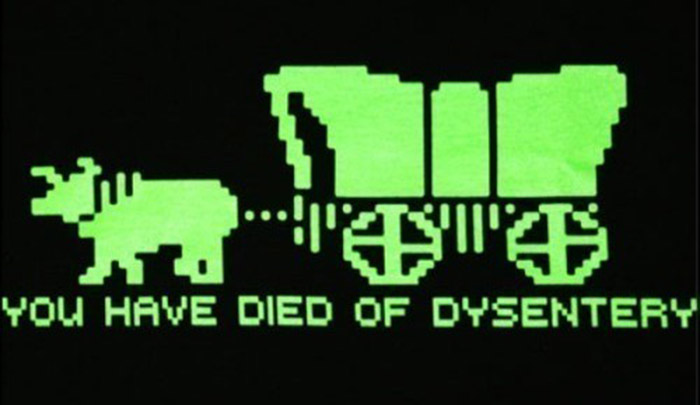
Traveling across the U.S. used to happen in a covered wagon. It involved snakebites and dysentery and a high probability that you might die while fording a river.
(Yes, I grew up in the Oregon Trail generation. And yes, I still play the old-school DOS version from 1990.)
Aren’t you tickled by the idea that you can hop on an airplane, watch a movie, take a nap, and the worst part of the entire experience is that you got a middle seat?!
I’m impressed with our species.
Oh, and guess what else?
- We landed on the moon.
- We’re going to Mars!
I can’t believe that in my lifetime (assuming I’m lucky enough to reach my senior years), I’m going to watch the first human walk on another planet. Wow. Can you believe what our minds are capable of creating?
We’re part of the human race, and we live during an amazing point in history. Isn’t that wild?
I could’ve been born as a turtle, but instead I got a neocortex. That’s pretty rad. 🙂
Back to Earth …
- We speak English. This is incredibly helpful for harnessing learning and work opportunities.
- We can read. According to UNESCO, 781 million adults over the age of 15 cannot. Two-thirds of the world’s illiterate are women.
These next two points apply to most, but not all, Afford Anything readers:
- We live in a first-world nation.
Did you ever see the South Park episode where the characters tried to explain the concept of an “appetizer” to a starving child?
“Well, um … it’s food that you eat while you’re waiting for more food … “
- We live in a country without war or fighting on its soil.
I was born in Nepal, a country that experienced a bloody civil war from 1996 to 2006, resulting in more than 15,000 casualties (10,500 civilian casualties).
In 2005, our (now-former) king seized absolute power, putting every politician under house arrest. One year later, he imposed a curfew on the capital city where my aunts, uncles and cousins live, ordering that any civilian violating the curfew must be “shot on sight.” Medical workers couldn’t get to hospitals. Food supply dwindled and prices soared.
What a f**king mess.
Fortunately, I lived safely in Colorado at the time, working as an entry-level newspaper writer and complaining about the fact that I only earned $21,000 per year. Oh no! I can only afford a small studio apartment! Woe is me! Life is tough!
I love my first-world problems.
I’m amazed by the possibility that I may spend my entire life — cradle to grave — without ever involuntarily entering a war zone. And without experiencing firsthand the effects of hyperinflation, hunger, or massive infrastructure disruption.
What a gift.
Back to other gratitudes:
- We’re healthy.
- We live in a stable country.
- Pillows.
- Coffee.
- Peanut butter.
- Flip-flops.
- Minty fresh toothpaste.
- Stretching.
- We live in climate-controlled environments.
- We can live with pets, if we choose.
- Kittens exist.
- Puppies exist.
- We discovered fire, created the wheel, developed agriculture, and invented Snapchat.
- This.
Don’t succumb to a scarcity/deprivation mindset, fueled by advertising hell-bent on convincing you that life is devoid of meaning unless you can manage your thermostat through your smartphone.
Instead, focus on the ridiculous abundance that’s already around you.
You have so much already.
And when you internalize this idea, you’ll find that you naturally want to spend less.
You’re willing to save more.
And you’re better able to parlay those savings into self-sustaining investments, so you and your family can enjoy freedom and security for decades to come.
Gratitude and Giving
I feel like there’s a natural link between gratitude and giving.
So let’s chat for a moment about the idea behind giving (and how to give the smart way).
Here are three thoughts:
#1: Giving is more than writing a check.
You hold some unique talent, skill or gift.
Maybe you’re a great listener. Maybe you’re empathetic and soothing. Maybe you’re patient.
Maybe you’re excellent at teaching specific skills, like how to change a tire, troubleshoot a computer, or hem a pair of pants.
Maybe you’re inviting and welcoming. You’re fantastic at helping others feel accepted in a group.
Yes, nonprofits need money, but the world also needs patience, understanding, teaching, mentoring, high-quality resources, compassion, thoughtfulness, kindness and smiles.
#2: Pick your favorite form.
If you ARE going to write a check, there are three types of recipients:
- Large organizations with Big Ambitious Goals (e.g., finding cures, protecting wilderness).
- Small organizations with a local focus (e.g., schools, animal shelters, low-cost health clinics).
- Microgiving.
Large: If you’re interested in giving to a large organizations, check out the group’s efficacy on a website like Charity Navigator, where you can compare multiple organizations that pursue the same goal or cause. The Wildlife Conservation Network, for example, scores 99 out of 100. (And you should see how adorable those animals are. Awww.)
Small: If you prefer local organizations, form a face-to-face relationship with the people who run these groups and with the communities they serve. Attend their events; create a person-to-person understanding of their impact on your local area.
Micro: Microgiving is broadly defined as focusing your resources on one specific person, family, or animal. Rather than pursuing a Big Ambitious Goal — like finding a cure — you’re targeting your impact on a precise recipient.
Benefits to this approach:
- There’s minimal administrative overhead (usually around 9 percent, including cuts for both website management and credit card processing).
- The total amount collected is much smaller — for example, $5,000 for one family — so you’ll be able to see tangible, measurable results from your specific donation. That’s pretty darn satisfying.
Two examples:
- After the San Bernardino shootings, more than 1,000 people collectively raised over $100,000 for the victims’ families (who are dealing with loss of income, funeral expenses, medical costs, etc.)
- This woman’s wheelchair was stolen, and donors raised $2,500 to buy a new one. (That’s fantastic, but it also raises the question: who the F$&# steals someone’s wheelchair?!?!)
Microgiving could happen in two forms:
- You hear about a specific person/family/animal — e.g. a friend-of-a-friend — who needs help. You send them an anonymous donation, such as a grocery store gift card.
- You facilitate a donation through a microgiving website, like GoFundMe or Microgiving. To support the arts community, check out Patreon.
Note: Donations to personal campaigns are considered gifts and are not tax-deductible.
Donations to 501(c)(3) nonprofits are tax-deductible. Not sure what’s what? GoFundMe displays a Certified Charity badge on nonprofit pages. (Or check out Charity Navigator, which shows rankings and reports from tax-deductible organizations.)
#3: The Afford Anything community is creating amazing things.
Several months ago, I started asking new email subscribers to hit “reply” and email me their biggest dreams, plus the obstacles standing in their way.
I’ve read hundreds of personal stories, incredible goals, and heartbreaking roadblocks. And I’ve noticed that many readers talk about wanting to give back.
- Some focus creating a legacy — “I want to make sure my family will be okay, even if I’m gone.”
- Some have specific ideas — “I want to create a sustainable off-grid eco-community.”
- Some have a sense that they want to do something, but they’re not sure what, how, or when.
- Some are involved with community groups or nonprofits, and they want to see their results grow.
Regardless of where you are within that journey, I’m proud of you — all of you — for your incredible heart and ambition.
This is truly one of the most amazing communities I’ve ever encountered, and I’m honored to be a member among us.
One Special Shout-Out
I want to give a shout-out to a few AA readers doing something cool:
Do you remember the giant earthquake that struck Nepal on April 25?
The earthquake killed 10,000 people and injured 23,000 more. It also devastated roads, hospitals, clinics and schools. The total damage represents 25% of the nation’s GDP.
(And Nepal wasn’t doing well to begin with. Talk about getting kicked when you’re down.)
An estimated 24,000 classrooms were damaged or destroyed in the quake. That’s a huge concern, given that 36 percent of adults in Nepal are illiterate (24 percent of men and 47 percent of women).
A few Afford Anything readers in Oregon are rebuilding a school located in Solukhumbu, Nepal, a Himalayan village near the epicenter of the earthquake, where 40 percent of homes were “fully destroyed.”
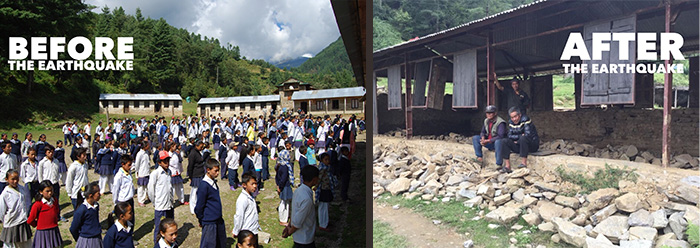
They’re working through the Nepali Association of Oregon, a tax-exempt charitable group. I like their approach of targeting one specific school, so the results will be tangible.
If you’re interested in supporting a school rebuilding, check them out.
Smile Through the Madness
Finally, I’d like to leave a note for every Afford Anything reader in a tough spot right now:
Many people in this community are in a good position in life. I’ve heard from hundreds of people who are trying to elevate from “good” to “great.”
But some readers are in dire straits.
I get emails from readers who tell me they’re stressed out about paying their electric bill.
If you’re in the latter camp, please remember a few things:
(1) Life will get better. This trouble is temporary.
(2) You live amidst abundant opportunities. Pick ONE opportunity to earn extra income on the side, and dedicate your time off work to pursuing this. Yes, you will need to work “in the margins” of life — 30 minutes every morning, 60 minutes every evening — but you have the power to create this time. Live your power.
(3) You can contribute to the world in many, many non-monetary ways. Staying positive is a gift.
Keep smiling. Stay strong. And look ahead to an amazing 2016 and beyond.