
Today is Afford Anything’s five-year birthday. Er, anniversary. Birthiversary?
Exactly five years ago today, I published my first blog article. Actually, I published my first five articles.
They were terrible.
Deplorable. Appalling. Ghastly. An affront to the English language.
I’ve edited those articles multiple times over the past five years. I wouldn’t go so far as to say that they’re “good,” but at least they’re no longer an insult to human dignity.
(Okay, I guess I’m being a tad melodramatic.)
Afford Anything is rounding into its birthday with more than 23,000 email subscribers, and this community is growing at a clip of several thousand new members every month.
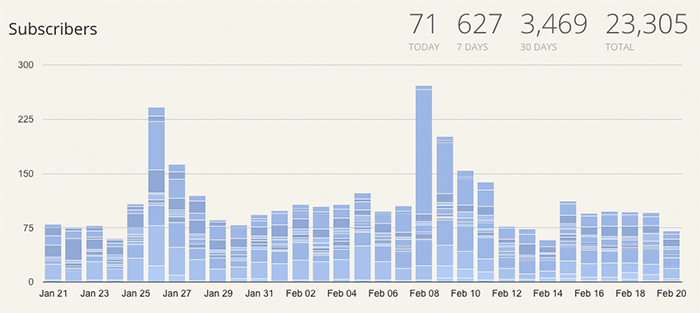
Last year (2015) we had 667,000 unique visitors and 1.89 million pageviews.
It’s a far cry from five years ago, when nobody read this site. Not even my mom.
I started the Afford Anything Facebook page in March 2011, and I didn’t get my first comment — not one freakin’ Facebook comment! — until September 2011.
Six months later.
Ouch.
I’d like to celebrate the five-year birthiversary with a behind-the-scenes tour into the business of blogging.
Afford Anything isn’t a website where I publish cat photos and talk about what I ate for lunch. (Thai food.)
This website has a strategic business plan, and I’d like to give you a backstage pass.
Here’s everything I know about blogging, condensed into a single post.
If you’re interested in running your own online business (or side hustle), I hope this will be helpful.
I imagine that you’ll fall into one of two categories:
- Those of you interested in online business or side hustles may find this interesting.
- Those of you interested in real estate investing or Airbnb hosting might be like, “Zzzzz. This is way too inside baseball.”
If you’re in the latter category, skip this article. (Don’t delete me from your lives just yet, though. We’ll return to our regularly-scheduled programming shortly. )
If you’re interested in running an online business, read on.
Please let me know in the comments if this is:
(a) Fascinating!
(b) Meh, okay
(c) A massive snoozefest; I’d rather watch Ben Bernanke floss his teeth.
Final disclaimer: I’m not an official expert. It’s not like I have a Ph.D. in blogging. I’m just a regular person who shows up everyday, works hard, and figures it out along the way.
Many bloggers have grown much more rapidly than I have. I try to learn as much as possible from them. This enterprise is an eternal work-in-progress.
The Business of Blogging
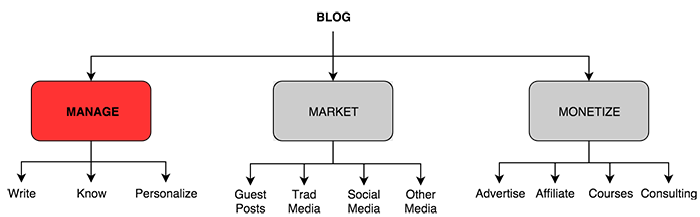
I organize my business into three buckets, which I call the “three M’s”:
- Management
- Marketing
- Monetizing
In simple terms, I define these as:
- Manage: Create an amazing reader experience.
- Market: Attract more readers into the community.
- Monetize: Make money, and reinvest it back into the site.
Here’s an in-depth walk through each of these.
(Note: This turned into a 6,000-word epic. You may want this as a PDF so you can read it on your Kindle, save it to your computer, or do whatever crazy things you do with PDFs.)
Management
This breaks down into a few sub-components:
- Write epic content
- Figure out what people want to read
- Personalize the audience experience
Let’s go through these one at a time:
Write Epic Content
Five years ago, I held the “more is better” philosophy on publishing blog posts. I published new articles every Monday, Wednesday and Friday.
These days, I emphasize quality over quantity.
My philosophy is that articles should be:
- Researched
- Actionable
- Scannable and easy-to-read
- Contain jokes, anecdotes, and occasional dialogue.
- Well-produced
Let’s break this down:
Research
It’s not enough to write some glib opinion and hit ‘publish.’ Each article should be backed by knowledge and research. For example:
This (controversial) article — Renting is Throwing Money Away … Right? — is packed with 5,500 words of heavy research, including:
- Historic APY rates
- Historic Dow Jones performance
- Historic average length of homeownership in the U.S. since 2001
- Robert Shiller’s research around inflation-adjusted home values since 1890
- An explanation of PITI
- …. and more.
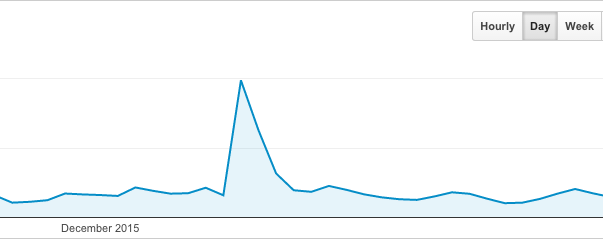
This article took more than 30+ hours to research and write, but it generated 10x attention and traffic. Lifehacker called it “mandatory reading,” and — well, here’s the traffic chart. See for yourself:
I can’t put that level of depth and research into every post, but there’s nothing on this website (in recent history) that’s taken less than 10 hours to write, edit and layout. Many posts fall into the 10-20 hour range.
(This article exceeds 30+ hours.)
Key takeaway: Spending 30 hours on one blog post is more effective than spending 1 hour (per post) on 30 blog posts.
Actionable
Most articles aren’t about economic theory. Instead, they contain specific actions people can take immediately.
Recent topics I’ve discussed, for example, include:
These are actionable, not theoretical. Blogs are an act of service to the audience, and the most popular bloggers recognize this.
Scannable and Easy-to-Read
Notice the tactics I use to make these articles easy-to-read:
- Short paragraphs (often as short as one sentence), with plenty of negative space (white space)
- Bulletpoints
- Subheadings to break up the text
I also keep sentences simple: subject-verb-object. For example:
“I organize my business into three buckets.”
The sentence construction is simple: [Who] does [what]
Here’s a great sentence from live coverage of the SpaceX Falcon 9 launch. The dude on the video, Tim Urban, was trying to explain SpaceX’s business model, and he states: “They bring things to space for people.”
Brilliant.
“Uh … brilliant? How? That’s preschool vocabulary.”
Exactly. Most people get mired in jargon.
“Blah blah payload suborbital boost thrust cryo-oxidizer stage engine blah blah blah blah.”
Look at the simplicity of his sentence.
[Who] does [what] for [whom].
“They bring things to space for people.”
No jargon. No rhetoric. No “trying to sound smart,” despite the fact that he spoke while surrounded by some of the most brilliant minds on the planet.
He reduced everything to its core: Things, space, people.
In fact, you could cut the words “for people” and curate the sentence to: “They bring things to space.”
(You can watch his remark here. I’ve cued the video to the proper starting point.)
By the way, see what I did?
I told an anecdote about a sentence I enjoyed. (Yes, I enjoy sentences.) Why? Telling a story is more interesting than: “keep your sentences simple.”
Notice what else I did? I not only provided a link to the video, I cued it to the best starting point — 18 minutes and 30 seconds in. That’s called delivering value to your audience, online-business-jargon for “don’t be a jerk.”
Jokes, Anecdotes and Dialogue
Today’s final writing tip: I’ll offset the text with blockquotes.
“What’s a blockquote?”
It’s that. That’s an example of a blockquote.
The benefit is that it creates both contrast and white space (negative space). This makes the text easier to read/scan.
Nobody likes chunky blocks of text. That’s not just my opinion. Eye-tracking studies show that articles with more negative space are more engaging.
(See what I did there? Provide research, not just opinion.)
“In these blockquotes, you ask yourself questions?”
Yes, I have imaginary conversations with myself. I’m doing it now.
“Why?”
People get engrossed in dialogue.
“People like to talk?”
Yes, exactly. Dialogue mimics normal behavior.
“Do you recognize the irony in trying to “mimic normal behavior?” Hashtag loser!”
I get it. Hey, do you see what I did there?
“No. What?”
I told a self-deprecating joke to add levity to this conversation.
“Levity? Are you serious? Nobody uses the word ‘levity’ in conversation.”
Touchè. I should edit that out.
“Nobody says “touchè,” either!”
Dammit. I suck at being human.
Blog Production Value
Back to my original statement:
My philosophy is that articles should be:
- Researched
- Actionable
- Scannable and easy-to-read
- Contain jokes, anecdotes, and occasional dialogue.
- Well-produced
We’ve covered the first four bullets. Let’s tackle the final piece: giving an article production value. This comes from qualities like:
- Images
- Charts
- Graphs
This is my weak point. I’m a writer, not a visual artist.
So I enlisted the help of the talented Stephanie Halligan, who draws motivational cartoons at Art to Self. (By the way, I recommend subscribing to that site. It’s a daily dose of awesome.)
Stephanie helped me create visuals around many of the concepts I write about. For example, she created these images to illustrate different retirement lifestyles:
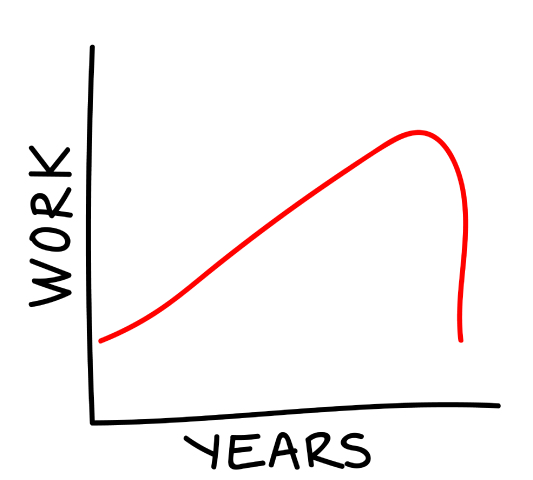
In this chart, Stephanie shows the traditional retirement model.
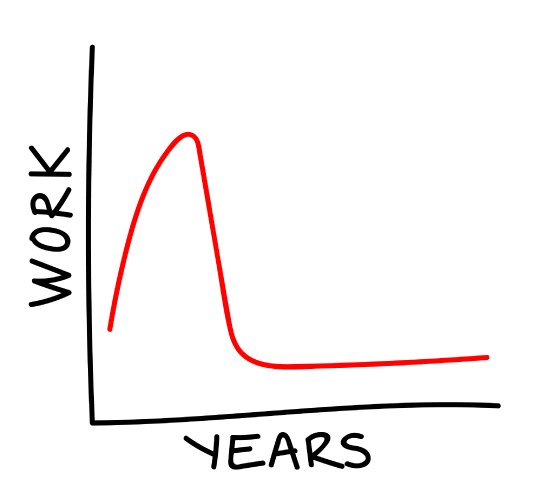
In this chart, she depicted the early retirement model.
Okay — see what Stephanie created?
I can write about these concepts, but Stephanie turns my concepts into visuals, which creates a better experience for you. (I hope. Right?)
Visuals are my weak spot, and that’s fine. I can’t be great at everything. That’s why I’m focused on building a team, not trying to be Superman.
(Stephanie also illustrated my free ebook, Escape, which you can download here. Also, check out her chart on try >> learn >> grow >> repeat. It describes, in one image, a concept that takes me thousands of words.)
Speaking of images —
Most images in recent posts have this type of font:

This has two benefits:
- I don’t waste time surfing through fonts.
- I create cohesive branding.
If an image has too many words, I’ll sometimes include a second font:

Or I’ll change it up through color:

I used to think that blogging was simply writing. Now I know it requires creating an audience experience through images, font, and design.
I used to think “audience experience” was some Disney boardroom buzzword. But visiting a website IS an experience, and it can either be good, bad or neutral.
Content Audit
When I started blogging, I’d publish articles “because it’s Wednesday, and I need to have something up by Wednesday.”
Those articles are crap. They should be banished from the earth. But if I hit “delete,” I’ll create a string of 404 Errors on the website. I need to redirect those URL’s elsewhere.
On top of that, many articles are good, but not great. They could use another editing round.
Enter: the “content audit” — a methodical overhaul of every article on this site. My long-suffering assistant Erin and I will:
- Delete crappy articles
- Edit the salvageable ones
Many people binge-read old articles, so I want to offer my best work. The content audit will improve this — ahem — “audience experience.”
I’ll tackle this after I finish creating the real estate course.
**UPDATE: Your First Rental Property, our premier real estate investing course, is live! If you’re interested in real estate, sign up for updates on when enrollment opens.**
Writing Blog Posts that People Want to Read
That’s my theory on writing and branding.
But does this resonate? Do you enjoy longer, in-depth articles? Or are people like, “whoa, TL;DR?”
Most bloggers offer unsubstantiated opinions — “Readers lose interest after 700 – 900 words!” — with zero data to support their claim.
I track everything. I test assumptions and make data-driven decisions.
I analyze many metrics, but the three I’ll touch on below include:
- How deep into an article people read
- The number of shares across social media
- The number of subscribers who open an email
Let’s start with the first:
Using a tool called Content Analytics made by a company called SumoMe, I can track how deep into articles people read. (To be clear, I can’t see the behavior of any individual user. I can only read anonymized, aggregate data).
This data tells me when I might be writing about the wrong stuff.
See, here’s the thing:
I’ve noticed that the old-school theory — “articles should be short, because people have short attention spans” — is wrong. People will read to the end of a long article IF the content is compelling.
In other words, “it’s too long” is a polite way of saying “it’s too boring.”
If an article has a high drop-off rate, I’ll scrutinize it. Do I need to break paragraphs into smaller nuggets? Are there too few images? What attribute is triggering people to leave?
Among these variables, the article’s topic yields the biggest impact.
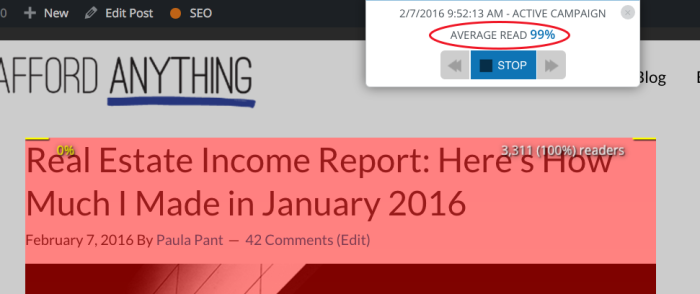
My real estate income reports get read all the way through:
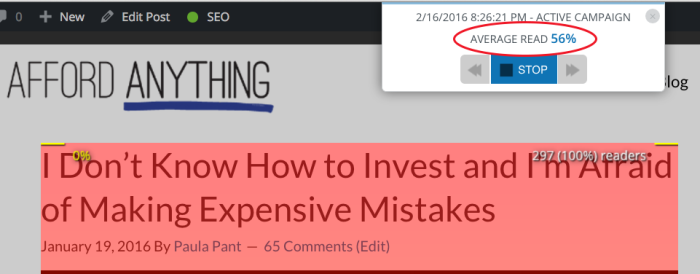
But this article about stock market investing has a low “average read” relative to most of my posts:
The average person drops off at this point within the article, where I start spouting useless trivia about Roth IRA’s:
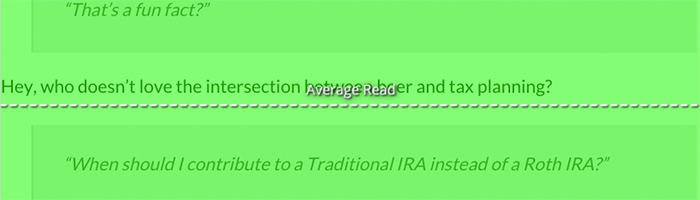
That’s a valuable insight. It tells me a few things:
- Nobody (other than nerds) cares about the history of the Roth IRA
- I don’t need to dive into the weeds on this topic
- Actually, maybe I should stop talking about it altogether
I make that third point because of this:
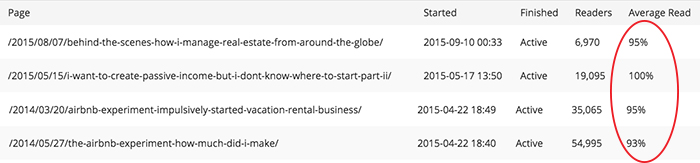
(NOTE: I’ve stitched the above image together to compress real estate/Airbnb URL’s into one convenient image.)
When I review the analytics, I see that readers tend to stick through my real estate investing and Airbnb articles. But I lose people when I talk about market investments.
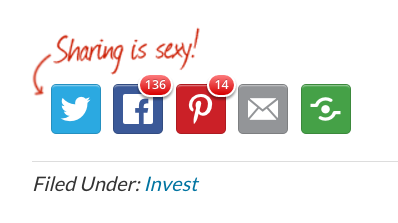
Anecdotally this makes sense. The majority of audience questions (emails, comments, etc.) involve real estate. I’ve also noticed my real estate articles get shared the most.
These were the shares on the rent vs. buy article:
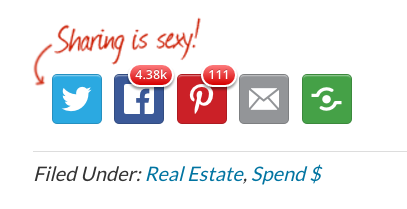
While these were the shares on the index fund investing article:
I can also see that the general investing article only had a 33 percent open rate (email subscribers who open the article):

By contrast, other articles typically range between 36 to 40 percent.

Oh, and here’s one more shred of evidence. Heat maps reveal click behavior:
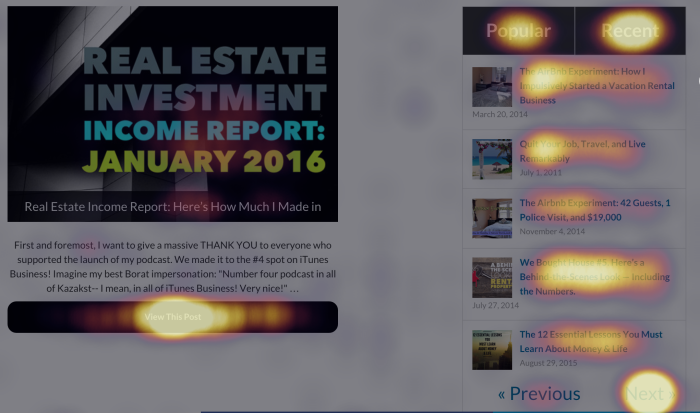
(I hope this data-gathering isn’t creepy.)
I see that readers click on all popular posts, but the real estate article (We Bought House #5) is the crowd favorite.
(Okay, I concede. It’s kinda creepy.)
Remember what I said at the beginning of this post?
- If you’re into online business, read on.
- If you’re into real estate/Airbnb, skip this post.
This is a data-driven statement.
Based on the analytics, I know that many readers come to Afford Anything for real estate education. I’ll warn them when a post is non-real-estate-related, so they don’t waste their time.
I’m setting expectations upfront, to create a better audience experience.
Personalizing the Blog Reading Experience
The final piece of blog management is creating a more personalized experience.
On the 1-on-1 front, this happens through direct interaction with you. This takes the shape of:
- Replying to blog and social media comments
- Responding to audience questions during the podcast
- Hosting free face-to-face meetups
- Trying to reply to emails (they come in faster than I can keep up with!)
The mass communication front, however, is where more fascinating business strategy comes into play.
Here’s the deal:
I talk about a LOT of topics. Many of my readers have targeted interests:
- Some are only interested in Airbnb.
- Some only care about rental properties.
- You — presumably, since you’re this deep into the article! — are interested in online business, entrepreneurship, and blogging.
My goal is to:
- Communicate with readers based on their interests …
- … without annoying people who aren’t interested in a given topic.
For example:
If you’re interested in rental properties, I’d like to send you more information about how to be a successful investor. If you’re not, I don’t want to clutter your Inbox with irrelevant material.
The question: How can I do this?
In a simplified manner, this is a two-step process:
Step 1: “Segment” the email list based on topic interest
Step 2: Send autoresponder emails to each specific segment
Let’s talk about this.
You might have noticed that there are roughly 824,502 ways that you can sign-up for the email list. (That’s a mild exaggeration.)
You can sign up through:
- The annoying mid-screen pop-up. (Sorry!)
- The box that emerges from the bottom righthand corner.
- The full-screen signup.
- The sign-up box on the homepage.
- The sign-up box at the bottom of the page.
- PDF downloads of individual blog posts.
Let’s talk about that last option: PDF downloads of blog posts.
This has been a HUGE accelerator of email list growth in the few short months I’ve been offering this.
Blogging experts say that you should offer “content specific opt-ins,” like a special checklist or spreadsheet that’s offered as bonus material for each individual article.
This post, for example, could (theoretically) offer a downloadable “get started blogging” bonus giveaway. But it doesn’t.
I’ve been wanting to create these content upgrades for months. But I told myself that I didn’t have the time.
I’m not going to throw some junk together. If I’m offering a free bonus, I want it to be good.
Even if I ask my assistant, Erin, to create a checklist or a spreadsheet, I need to project manage: explain the vision, give her direction, review, revise, edit and approve the material. This requires both time and mental energy.
As you know, I’m hyper-judicious about my time and energy.
Then I realized “done” is better than “perfect.” I began PDF-ing my articles and offering these as a free giveaway.
(I’m declaring “PDF-ing” as a word.)
Anyway, PDF-ing appears to be a win-win: Subscribers get a free gift, and I’m not tasked with creating new material.
(If you’re already on the email list, you can download any of the PDF’s without getting subscribed twice, assuming you enter the same email address.)
Okay, why am I talking about this? Here’s where segmentation comes into play:
If a person downloads a PDF related to real estate investing, that’s an indication they’re interested in real estate investing.
Genius, I know.
** Takes a bow. **
#Self-Deprecating #Levity
Readers who download real-estate-related PDFs are subscribed to the main email list, but get tagged as “real estate.”
Readers who download Airbnb-related PDFs are subscribed to the main email list, but get tagged as “Airbnb.”
At this point, “real estate” and “Airbnb” are the only two tags I maintain, although in the future I’d like to create additional tags like “online business,” “money basics,” etc.
Admittedly, this system is flawed for multiple reasons:
- I didn’t do this from the start, so I have little-to-no information on what my longtime subscribers are interested in.
- Some people are PDF hoarders who download everything. (Hey, no judgment!)
- Probably many more reasons I’m blanking on right now.
I’m not doing this yet, but my 2016 goal is to create a sequence of emails that are delivered to new subscribers based on these tags. This is called an “autoresponder sequence,” and it allows people who are new to the website to get the most relevant, helpful content around their interests.
Let’s say you find this website after running a Google search for “how to become an Airbnb host.” You download the free Airbnb guide, and after reading it, you want to continue learning more.
I want to make sure you get exactly what you’re looking for, as soon as possible.
This is as simple as setting up an If-Then sequence:
If: tagged as “Airbnb”
Then: send article(s) starting #X days after you subscribe
I tested this idea last month. I sent the Airbnb-tagged list (around 500 people) an email that I wrote specifically for them, in which I talked about how to reduce whiny guest reviews.
Around 45 percent of subscribers with that tag opened the email, which is about 7 percent better than my main list’s open rate.

I know the difference between 38 percent vs. 45 percent open rates might not sound like a lot, but in the online business world, that’s significant.
Sure, it’s only one data point. But it indicates that topic-specific emails are more engaging and can better serve my audience.
(My confirmation bias loves it!)
I can send Airbnb-related emails only to the readers who want it. I don’t need to annoy everyone else.
Ask for the Opt-In
In addition to tagging, I also ask readers to opt-into specific segmented lists, such as:
- The VIP List for the real estate course
- The Podcast list
This is a better indicator of interest, for obvious reasons.
I send specific emails to these groups that main-list subscribers don’t receive. For example, I surveyed the VIP List to see what material they want me to cover during the course.
These emails get opened at roughly an average 70 percent rate. (That’s double the open rate of the main email list.)

(Advanced) key takeaway: asking existing subscribers to opt-into a specialized list is the single best way to create effective segmentation.
That’s why I keep putting these sign-up links in every email.
(Ahem … you can sign up at those links above. Ahem.)
Oh, and also —
Since you’ve read this far, I assume you’re interested in online business. Sign up here to get updates about running an online business. You’re the ONLY people who will get these emails.
(See what I did there? Eh? Ehhh?)
** Takes another bow. **
#TheLevityIsKillingMe
“Too soon, Paula. You just told the ‘levity’ joke a few paragraphs ago. It’s too early to re-introduce it again.”
Hey, dialogue blockquote! You’re back!
“Yep. It’s a good idea to circle back to ideas you introduced earlier in the article. It gives the piece an overall sense of cohesion.”
But won’t that get repetitive?
“You don’t need to elaborate. Just touch on the concept, so it’ll move from people’s short-term to long-term memory.”
Got it. Thanks, blockquote!
“Hey, while I’m here, I have a message.”
Yeah?
“You’re 3,000 words deep into this article, and you’ve ONLY COVERED MANAGEMENT! You have two more “M’s” to go! Get on with it!”
Duly noted!
(Note to any terrified readers: Don’t worry. The next two M’s — marketing and monetizing — will be much shorter.)
(And there will be cake at the end!)

Blog Marketing 101
As you’ll recall:
- Marketing is bringing readers to Afford Anything
- Management is giving them a great experience while they’re here
How do I bring new members into this community? Broadly:
- Guest posts
- Media interviews
- Being active on social media
Notice that search-engine optimization (SEO) is not on the list. That’s not an oversight. That’s by design. (Details below.)
I’ll highlight each tactic:
Guest Posts
Okay. You know when Rihanna and Eminem create a track together? And Eminem’s fans get exposure to Rihanna and vice versa? And some of these listeners stick around as longtime fans?
That’s the idea behind guest posting. Enough said.
Media Interviews
Media interviews don’t consume much time (relative to writing guest posts). But the value is a crapshoot: depending on the publication, this can either be an amazing traffic source or a mind-blowing dud.
The best predictor of results isn’t the size of the website’s readership, it’s the volume of content they produce.
If you’re featured in one of 30 new articles published that day, there’s a good chance your name will get lost in the mix. But if they’re not a content farm, you have a better shot at standing out.
In the beginning, I would solicit interviews with websites, newspapers and magazines through free websites like HARO (Help a Reporter Out), a matchmaking service between journalists and sources. These days, I just maintain a media page and wait for publications to come to me.
Social Media
Don’t be on every social platform. Choose a few, and manage them well. I’ve chosen Facebook, Twitter, Instagram and Pinterest. (That’s arguably too many.)
Why those?
A website called Shareaholic studied more than 200 million unique visitors who went to 150,000 websites over a three-year timespan. They found that:
- Facebook drove around 25% of that traffic
- Pinterest drove around 5%
- The next-six-biggest social platforms (Twitter, LinkedIn, Reddit, G+, StumbleUpon, YouTube) drove less than 2% of traffic
A three-year-timespan is a generation in Internet Years, but those trends are worth noting.
Random social media marketing lessons:
Facebook: Be helpful. Don’t promote too often. Focus on sharing awesome content. Let the rest unfold naturally. Occasionally ask for the like.
I’ve experimented with running ads on Facebook. Nothing major yet; I’m testing and data-gathering. It’s too early to report results, but if you’d like to learn more about Facebook ads, Amy Porterfield’s podcast episode 92 is a great start.
Pinterest: I have zero interest in Pinterest. And it shows. My once-ugly Pinterest page, which delivers almost no traffic, is proof.
A few years ago, I blamed my lack of traffic on external factors. “Oh, finance just doesn’t perform well on Pinterest.”
Then I noticed other finance blogs getting insane traffic from Pinterest, and a cold truth sank in: I need to direct responsibility inward. The problem isn’t the platform. The problem is me.
So I sought help.
Do you remember the article I wrote about Erin, an Afford Anything reader who saved a year’s salary, quit her soul-crushing 9-to-5, and started freelancing full-time? She’s moonlighted as my very-part-time assistant for about a year. Two months ago I hired her as Afford Anything’s Chief Sanity Officer. One of her many responsibilities is taking control of my now-improving Pinterest account.
Erin is responsible for a trillion other details; my head will explode trying to name them all. I already wonder how I survived without her.
SEO is Overrated
Finally, the piece that’s not on the list: search engine optimization, or SEO. That’s industry-speak for “getting to the top search results in Google.”
Here’s the deal: One aspect of the old theory around SEO (carried to its logical extreme) was to stuff your content so full of keywords that it looked unreadable to humans.
So the Internet wound up full of garbage like this (highlights mine):

Obviously I’m not going to write articles like this. Would I write articles like this? I won’t write articles like this. Who writes articles like this? Now when someone asks, “would you write articles like this?,” I can say, “I don’t write articles like this.” Put another way, I wouldn’t write articles like this!
(Hey, in other news, this website is now ranking well for the keyword phrase “write articles like this!”)
Kidding. #NerdHumor
A better approach is to base articles around search data. Let’s say I run a Google search for “real estate” and then look at auto-fills:
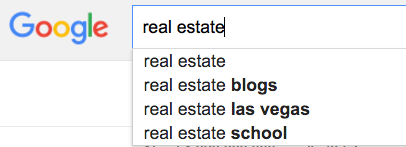
I also look at related searches:
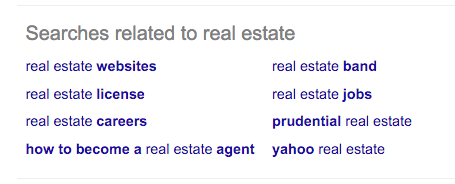
In theory, I’d write articles to match search: “25 Best Real Estate Websites!” or “30 Types of Real Estate Careers You Haven’t Considered!”
But — groan — that’s been done a million times.
I believe blogs should be inspired. Thoughtful. Brimming with insight and ideas you can’t find elsewhere.
When I create an article, I mull over the topic for days or weeks. I read, I talk, I listen, I reflect. When I eventually begin writing, my brain shuts down and my fingers take over. The world falls silent. Words pour from my fingertips as I stare at the screen, wondering what my hands are about to say.
(That’s on a good day. On bad days, I stare at a blank screen for hours.)
So … no. I’m not going to create SEO-fueled content around “How to Get a Real Estate License in 7 Steps.” If that means that Google doesn’t like me, that’s fine.
I should add that there are non-content steps that people can take to improve their search ranking, like fast website load times, fixing broken links and avoiding 404 Error pages. I’m 100% in favor of this, because it enhances the reader experience. I’m not serving you well if I have a website load time that’s slow-as-snails.
Disclaimer: There’s a LOT more to say about SEO that I’m leaving out for the sake of time and brevity.
I’ll be the first to acknowledge that I’m oversimplifying SEO and we should have a more detailed discussion, but that’s outside the scope of this article. If you’d like to learn more, this guide by Rand Fishkin is a fantastic starting point. Also, join the online business list to receive special updates about this.
I should further add that topics like “How to Get a Real Estate License in 7 Steps” can be helpful and engaging, if it’s inspired. That type of article isn’t right for Afford Anything, but it holds a valuable place on the Internet.
(By the way, what time is the Super Bowl?)
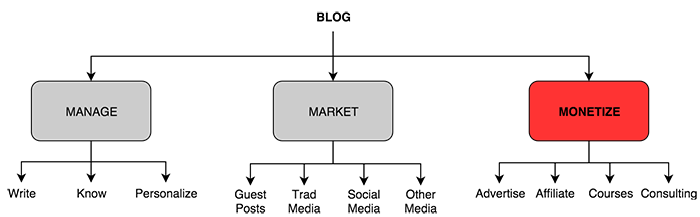
Do you see what I’m doing with these graphs?
I’m giving you a roadmap so you can chart your progress through this post. I learned this from Pat Flynn’s SPI Episode 17 on YouTube; I’ve cued the video to the proper starting point if you’d like a lesson.
Monetization
You’ve reached the final “M.”
At this point, you’ve peeked at behind-the-scenes blog management. I hope I haven’t scared you. Five years ago, I didn’t study heat maps or run analytics or observe open rates. I just wrote.
That’s all you need to do to begin. Start a blog. Write. The rest comes later.
Okay. How do you make money as a blogger? In a nutshell, the most popular methods are:
- Advertising
- Affiliate revenue
- Selling products or courses
- Consulting
Let’s chat briefly about the last option on that list, then dive into the other three.
Consulting
Last year, Afford Anything earned revenues in the low-six-figures. (That doesn’t include real estate income, which is a separate entity.) The majority comes from consulting for other businesses.
You see, most businesses need a blog and social media presence. But there are no credentialed experts. Nobody has a Ph.D. in blogging.
Big companies can hire in-house teams. But smaller companies — like financial planners, accountants, real estate brokers, and tech startups — outsource their online marketing. That’s where we come in.
I set up a consulting company called Catalyst a few years ago; Afford Anything is the lead generator. Most clients find Afford Anything and follow the link trail to Catalyst.
I know, because I track.
This is a weird business model. Statistically speaking, my clients represent 0.00001 percent of my audience. (That’s not an exaggeration. Multiply 667,000 unique readers per year x 0.00001. That’s six. Well, it’s 6.67. That’s roughly the number of new clients we’ll onboard each year)
Why choose such a weird business model?
The benefit is that I don’t make editorial decisions based on making money, which is why you’ll never read “10 Best Credit Cards of 2016!” at Afford Anything. (I could make a killing in affiliate commissions if I published an article like that, but I’d be prioritizing revenue over serving my audience, and I’m not willing to do that.)
The drawback is that every hour that I spend with clients is an hour I’m not engaging with this community. It’s an hour not answering reader emails, drafting blog posts or whacking trolls in the comments.
That sucks.
I pondered how to handle this and I decided to follow classic advice: Eliminate. Automate. Delegate.
I took that in reverse order. First, I delegated.
- I hired a writer named Kristi. (She only writes for Catalyst clients. I write everything at Afford Anything.)
- I hired a project manager named Kayla.
- [In the works] — I sent an offer to an editor who may come on-board, as well.
Once I hired this team, I was like, “Oh crap, now we need processes!”
That’s when Catalyst began to automate — or more accurately, to systematize. We created boundaries like:
- This is our standard menu of options
- These are the ONLY platforms we work with
This minimizes our need to create a custom workflow for every client.
After I delegated and systematized, the final step was eliminate.
I chatted with a successful entrepreneur a few months ago and told him I’d like to drop a few clients. He offered fantastic advice: Don’t drop your clients. Raise your rates.
Brilliant.
Last Thanksgiving, I told several clients my rates would rise effective 2016. (Likewise, my assistant told me that her rate would rise, as well.) Many clients decided to find a cheaper alternative, which is fine; I’d planned to drop them anyway.
Here’s the funny part: When I started Catalyst, I was terrified a client would drop me. Now I’m dropping them. I’m choosing projects and clients I enjoy. As an entrepreneur, that’s a fantastic feeling.
Catalyst now consumes about one workday per week, leaving the other days open for me to focus on Afford Anything. It’s a six-figure, one-day-per-week commitment. This blows my mind and feels slightly surreal. It’s the near-literal embodiment of the four-hour-workweek.
(UPDATE September 2017: I’ve now killed off 100% of my Catalyst business so that I can focus entirely on Afford Anything. That’s right, I had a six-figure location independent business and I killed it on purpose. A younger version of myself would have found this unthinkable. But I just don’t want to do it anymore, and I don’t have to. I’d rather focus on the blog and the podcast. So here we are. :-))
Affiliates, Advertising, and Courses
This website doesn’t earn much direct revenue. Given the time I spend here, plus the high cost of running this site, I’d like Afford Anything to generate direct (non-consulting) revenue.
But how?
One possibility is affiliate revenue. If I recommend a product or service and people click through the link to use it, I’ll get a commission. Right now, I earn pocket change from this. That’s by design. I don’t want to push a bunch of posts that scream, “sign up for this savings account!”
Here are my two ethical stances around this:
- I only affiliate to products/services I use myself.
- If I like a product/service, I’ll share it whether or not it has an affiliate program.
I like Vanguard; they don’t pay affiliate commissions; I talk about them anyway. I also like Personal Capital, and I think Bluehost is great for new bloggers. Why wouldn’t I tell you about them? And why wouldn’t I include an affiliate link when I do?
I feel good about that. But I DON’T want to start adding “sign up for Personal Capital!” at the bottom of every article. I think it creates a crappy audience experience. And that means my ability to earn affiliate revenue is limited.
Affiliate revenue brings in not-even-enough-to-cover-costs, and I’m not willing to compromise content to increase that. So … I’m going to need a different direction.
Next up: advertising.
I don’t want to do it.
I think banner ads are ugly. They distract from the audience experience. And they’re not even that lucrative.
At my peak, I earned around $700 per month from Google Adsense, but I hated the look of the website. So I asked myself: “Would I pay $700 per month for a better-looking website?” My answer was yes, so I removed most ads. (There’s a small one buried deep in the footer. It brings in around $200 per month.)
In effect, I pay $500 a month to not annoy you.
That leaves one final monetizing strategy: selling courses. I love this option because I know I can offer huge value. I’ll pour months into creating massively helpful material.
I’ve spent a lot of time reflecting on my first few years as a rental property investor. There was so much I didn’t know. So many differing voices and opinions. So much hype. It felt impossible to wade through it all.
I’m creating the course that I would’ve wanted, back when I was a rookie investor.
(That’s a saying, right? “Do unto others as you would have done unto your former self in an alternate universe?”)
My first course is comprehensive preparation for your first rental property. Building this course is my singular focus in 2016.
Sign up here to learn more about Your First Rental Property.
We Made It!
We’ve reached the end of the longest article I’ve written. I have no idea how to end this piece.
“You’re not supposed to admit that, Paula.”
Blockquote! You’re back for an encore!
“Yeah. You’re lagging, so I thought I’d liven things up. Plus, repetition is a good teacher.”
Ahh, I’ll use that technique in the course.
“Nice tie-in.”
Thanks. Anyway, I need to get back to ending this blog post now.
Most blogging experts would recommend that I end with a call-to-action, like “sign up for more about the course!” or “start your own blog!”
Oh wait. I just did that.
Hmmm. Seems like an unfulfilling way to end.
Instead, let me thank you for sticking with me — not just to the end of this monster post, but for the months and/or years that you’ve been a part of this community.
You are the reason that I write.
Thank you.