Note from Paula: In my last post — Part 1 – I described how I searched for a rental house. In today’s post, I’ll spill the details of how I put the deal together.
****
To say that the house is a “fixer upper” is too polite.
The house is –- well, it’s safe for human habitation. I think.
Cable television seems to think that a ‘fixer upper’ simply needs a makeover. Rip out the peeling yellow laminate. Toss in some granite and hardwood. Poof – instant fix.
Haha. If only.
This house has crazy core problems. There are no gutters, rotted doorjams, awful fascia, and the floors feel like mush near the doorways.
Water damage? Check.
Rot? Check.
Mold? Check.
Leaking pipes? Check.
Wonky foundation? Check.
Electrical issues? Check.
Real estate investors are used to dealing with these problems. After all, the house is 101+ years old (and it’s been neglected for at least two dozen years by absentee owners). What do you expect?
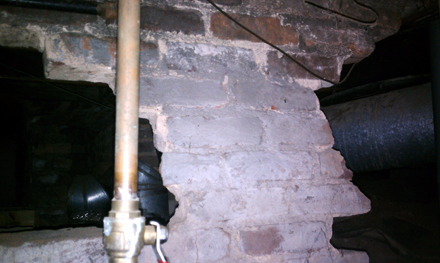
But one issue scared every other investor away: the sinking foundation.
Imagine a concave object, like a cereal bowl – high on the sides but low in the center. That’s what the house looks like; it droops several inches in the middle.
Some of the “support beams” are nothing more than thin planks of wood propped up on cinder blocks.
You feel a little like you’re in an amusement park fun house.
Real estate investors are fond of fixer-uppers, but many get scared by a bad foundation.

When others are fearful, I see opportunity.
Two experts separately evaluated the basement. A third-party certified inspector spent the better part of an afternoon documenting every flaw.
After lots of scrutinizing, every inspector declared the same opinion: The foundation is “fixable” (although I believe one of them described it as a “sponge on toothpicks.” Yikes!)
Okay, we’ll tackle the foundation. Next question: Would it appeal to tenants?
W.W.T.W. – What Would Tenants Want?
The house has nice “bones” – high ceilings, huge windows, lots of light. Those traits impress tenants.
More importantly, the house is divided into two single-bedroom units and one three-bedroom unit.
Single bedrooms are ideal. It’s easy to find one person – just one person – who wants to live there.
Three-bedrooms are tougher to rent. Heck, it’s hard enough getting three people to pick a restaurant for dinner. “Let’s get Italian! No, let’s get sushi!”
Imagine how hard it is to find three roommates who agree to rent your home.
Typically, families with children will rent 3-bed, 2-bath homes, while single young professionals opt for 1-bed or 2-bed units. This neighborhood tends to attract young professionals who want an urban lifestyle (rather than families looking for good schools), and this gave me a bit of pause about taking on a 3-bedroom unit.
Fortunately —
The 3-bedroom unit is the most beautiful space in the building, with huge windows, high ceilings, hardwood floors and Craftsman-style turn-of-the-century character. If three people are going to agree on any space, this would be a great one. I gave it a thumbs-up for marketability.
Now all we needed was money.
Show Me the Money!
The first banker said no.
My then-boyfriend/now-ex and I had just returned from backpacking around the globe. I think that’s awesome. But as it turns out, bankers don’t look kindly on unconventional lives.
Result: Rejection!!
But we kept trying. Here’s my little secret: keep trying until someone says yes.
Even if you want to claw your eyeballs out in the process.
Eventually it becomes a numbers game. Ask enough people and eventually someone will say yes.
They’ll demand a higher down payment. They’ll charge a sky-high interest rate. They’ll make you sign over your soul, your kidneys, and your firstborn child. But someone will ultimately say yes.
We got smacked with a higher interest rate: 5.375 percent at a time when everyone else was getting approved at less than 3 percent. That’s the punishment for living unconventionally, I suppose.
The other trade-off was that we could only obtain a $200,000 loan. Would that be enough?
The house was priced at $420,000 in 2008. An investor went under contract at $380,000, but pulled out after inspection.
A second investor went under contract at $325,000, but pulled out.
A third investor went under contract at $285,000, but pulled out.
By the time I spotted it, the house had sat on the market for 16 months. The owner was heading into foreclosure. He was desperate to sell.
We offered $225,000. Most of that money came from our loan, with $25,000 plus closing costs out-of-pocket (about 12 percent). The homeowner agreed.
The Rotting Building …
But the homeowner owed $325,000 on it. His bank would lose the $100,000 difference. Were they willing to do that?
I wrote – I’m not joking – a 24-page letter detailing all the structural deficiencies of the house, pleading a case for why a home in such bad condition should sell for a $100,000 discount. We argued that no one else would buy a house with foundational problems, and noted that the bank would lose even more money if they sold the house at a foreclosure auction.
And I included pictures. Lots and lots of pictures.
All unflattering.
The bank said yes. I’m now the proud owner of a rotting building.
But I took a risk — and a six-figure debt. Would it pay off? Tune in to Part 3 to learn how it’s doing, one year later.
Updated in 2020 to reflect relationship status.
