This is Part II of the Passive Income for Beginners series. Start by reading Part I here.
When I quit my 9-to-5 job, I had no concept of passive income.
Like most people, I conceptualized money in terms of time: “they pay $25 per hour” or “she makes $60,000 per year.” When I quit my job, I figured I’d live on savings for a few years and then return to the workforce.
That’s what I did — kinda. After two spectacular years of mini-retirement, I recoiled at the idea of working for someone else, so I choose the most unrestricted career path I could imagine: a full-time freelancer.
Back then, I didn’t grasp the difference between being self-employed vs. being an employer vs. being an investor. Like many newbies, I lumped these under the same umbrella: Not-Workin’-for-the-Man.
(Can you lump something under an umbrella?)
I thought I’d achieved the ultimate work-life victory: I’m my own boss! I can work from anywhere on the planet! I can spend a month in Brazil on a whim! Wheeee!
Although I’m obviously being flippant, freelancing is an incredible lifestyle. The freedom to make your own hours, travel anywhere, fire annoying clients and wear yoga pants everyday is one of the best lifestyle decisions I’ve made.
But despite its upside, the freedom of self-employment wasn’t enough.
I know, I know. Call me restless. Call me ungrateful. Call me the prototypical Millennial, always wanting more.
But I wanted more!
Self-employment was my first step, not my last. I wanted freedom from the need to work.
There are two ways to do this:
- Option A: Be broke. (Remember that line from Office Space? “Well, you don’t need a million dollars to do nothing, man. Take a look at my cousin. He’s broke, don’t do shit.”)
- Option B: Create passive income.
For obvious reasons, I picked the latter.
Here’s how I began — and the path I’d recommend to my fellow Rebels.

The Set-Up
At a conceptual level, I hope that the rest of this article could help all of my readers, no matter where you live or what financial situation you’re in.
However, at a specific level, the rest of the article is aimed at you if:
- You live in the U.S. — The laws, tax code and banking system are different in every country. While I’d love to help readers around the globe, I can’t specialize in everything; I can only focus on the U.S. financial system.
- You don’t hold credit card debt. — If you’re paying an 8 percent interest rate or higher, focus first on destroying debt.
- Don’t panic if you hold low-interest loans, such as a student loan at 3 percent APR. You can make stronger returns (with manageable risk) and pocket the spread. (For a more detailed discussion about this idea, read this and this.)
- Side note: I disagree with people who paint debt as “good” or “bad.” There are no moral judgments in finance; only math. Debt isn’t good or bad — it’s profitable or unprofitable.
- Using a credit card for everyday spending (like groceries and gas), and paying the balance in full at the end of the month, is an excellent way to “give yourself a raise.” Make sure you’re getting either airline miles or cashback. Here’s an updated list of the best sign-up bonuses; the offers keep changing, so this list gets updated frequently.
- You have good credit. — Credit is a passport. It’s tough to reach your final destination without it.
- To improve yours, check out this article on improving your credit score.
- You’ll take reasonable risks. — I’ll never recommend spammy get-rich-quick crap, but I also don’t recommend hugging a savings account and CD for the rest of your life.
- You’ve got hustle. — ‘Nuff said.
As we chatted about in Part I of this series, there are dozens of effective ways to create passive income. I’m focusing this article on real estate investing, not because it’s “the best,” but because it worked for me.
I want to be clear that the following plan isn’t the only route to passive income; it’s one roadmap among many. I share it because it’s how I myself did it — and it’s what I’d do if I were starting from scratch again.

The Passive Plan
I could write a chapter about each step below, but for the sake of cramming this into a 2,400-word article, here’s the roadmap.
#1: Shop for Mortgages.
Unless you’re sitting on a pile of cash, you’ll need a mortgage to buy an investment property. You have a few choices:
- Get an FHA-backed mortgage, which requires only a 3.5% downpayment.
- Get a conventional mortgage with 10% to 20% down.
- Get a VA mortgage (if you’re a qualified veteran).
- Get a private loan from an investor (worst-case). To find this, Google the name of your city, plus “REIA” (real estate investors association), and attend a few of their meet-ups. This is where private lenders tend to hang out. This is the worst-case scenario, because you’ll get the highest fees and rates, so exhaust all other options before you take this route. Also, know that finding this as a rental investor is tough; most private lenders target flippers.
If you’re deliberating between an FHA-backed loan vs. a conventional loan, here’s a detailed article I wrote for the Motley Fool on the pro’s and con’s of FHA loans. (Long story short: Get a conventional loan if you can afford the downpayment. Get the FHA if you can’t.)
#2: Buy a Multifamily Building.
Purchase a duplex, triplex or 4-plex building.
“WTF?!?! You might as well have said, ‘Step two, colonize Mars.'”
I know this is intimidating at first glance. But if you’re hunting for passive income, multifamily properties are a beginner’s best friend.
“Why? I’m already a homeowner. Why can’t I just move and rent out my current house?”
You could. But I bet you didn’t analyze your own property as a rental before you bought it, did you?
“Well, no.”
What are the chances it’ll provide a decent ROI? What’s the cap rate? What’s the net operating income?
“Uhhhh ….”
Yeah, I thought so.
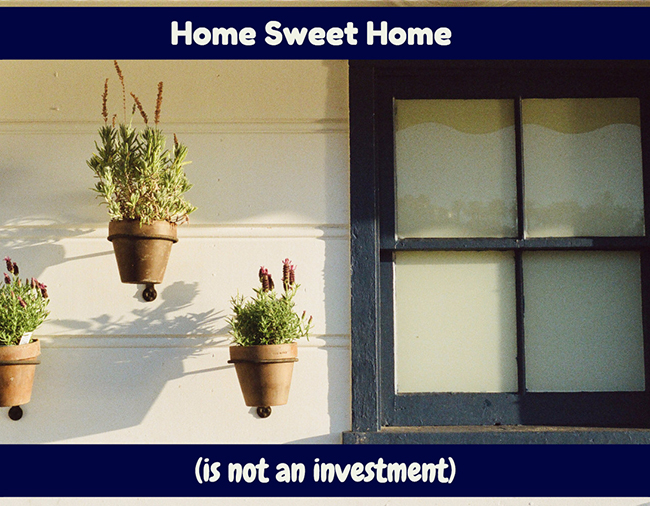
“But a home is an investment.”
Do you create quarterly profit-and-loss statements for your home?
“No.”
Then it’s not an investment.
Okay, where were we? (Before my inner monologue started interrogating itself.)
(Wait — doesn’t that make it an inner dialogue?)
Anyway — back to the multifamily you’re purchasing. Look for something with 2-4 units. Buildings with fewer than 5 units are considered “residential,” which are easier to finance than a “commercial” building (5+ units).
“But Paula, I don’t have a downpayment.”
No problem. If you’re willing to move into one of the units, you can qualify for an FHA or VA loan, which requires only 3.5 percent down (FHA) or no money down (VA).
“Why buy a multifamily? Sounds scary.”
Let’s assume you’re a renter, looking for your first home. You analyze the numbers and pick an ideal rental property, a single-family residence (SFR) with an owner-occupant mortgage.
You close on the house. One month passes. You don’t earn a dime in passive income. The month after that, still no dime. Then another. Then another. Still no money.
You need to live in the house for a year, move out, buy another house, and lease the first one. And then you’ll finally start collecting … one unit’s worth of income.
Yawn.
By purchasing an SFR, you’re deferring income by a year (boo!), and when you start to collect it, you’ll earn a small amount from one unit (double boo!). If you purchase a multifamily, you’ll earn money from Day One (yay!) and collect revenue from multiple units (double yay!).
“But isn’t a multifamily expensive? I can barely afford my own house.”
One of the most frequent questions I receive is from people who say: “Every house in my area costs $450,000, but only rents for $2,200. How can I possibly turn that into a profitable investment?”
You can’t. You’re looking at the wrong type of dwelling in the wrong location.
(This question almost always comes from someone looking at SFRs in upper-middle-class or wealthy suburbs flanking huge cities. That’s their first mistake.)
First of all, stop looking for a house, especially in Class A neighborhoods. Look for a property, not a home.
When you buy an SFR, you’re competing with a massive pool of owner-occupants. Regardless of how much they delude themselves with “my home is an investment” self-talk, they’re not actually buying the home as an investment. They’re buying based on raw emotion.
“Oohhh, we can put the china cabinet here! We can host dinner parties in this room! Look at the size of the backyard!”
When you buy a multifamily, you’re competing with investors – and we base decisions on math. As should you.
That’s why multifamilies are often priced at a multiple of gross rent, rather than a pie-in-the-sky number born from enthusiasm and fluffy feelings.
“Multiple of gross what? Paula, I have no idea what any of that means.”
The bottom line is that the cost-per-door of a multifamily is typically lower than the cost-per-door of a comparable SFR, all else being equal (similar age, style, size, location, quality). If you’re willing to look at Class B or Class C neighborhoods, or venture into the countryside, you’ll likely find even better deals.
“Ah, got it. Okay, next question: Moving is a hassle. What if I don’t want to?”
If you’re not willing to move into the building, you’ll need to get an ‘investor loan,’ but these are more expensive, require a higher downpayment, and are harder to obtain.
If you’re baller enough to bear those costs, more power to ya. If you can’t cough up the funds, though, a multifamily helps you get your foot in the door. That’s why it’s a beginners BFF.
“Anything else I should know?”
Yep. Since you’re living in your multifamily, pay yourself rent. After all, you’re taking the spot of a paying tenant. You don’t need to move the rent payment into your business account; just set it aside in savings each month.
#3: Be Scrappy
[[“Because I’m scrappy / Clap along if you feel like a room without a roof / Because I’m scrappy / Clap along if you feel like scrappiness is the truth.]]
You’re a beginner, so at this stage in the game, you probably have more time than money. If that’s the case, conduct the repairs yourself and manage the property yourself for the first few years, but don’t engage in BS accounting.
Don’t pretend that paying yourself $0 means your so-called “profits” are higher. It’s fine to DIY work at the start of the game, as long as you pay yourself for your time.
Remember, there are two players involved: Owner You and Worker You. Run the numbers so the Worker can quit, the Owner can hire a replacement, and the numbers stay the same.
To clarify: It’s fine (and normal) to handle some of the work yourself, especially as you’re getting started. Just don’t concoct imaginary numbers based on that.
If you’re in the opposite situation — if you have more money than time — that’s great. In fact, that’s preferable. There’s nothing I love more than investors who start building their team on Day One. Success is not a solo act, and the ultimate name of the game here is “passive.”
#4: Pile the Profits
If you bought correctly, you’re now living “for free” (paying rent into your savings) plus pocketing extra cash. Save every dime of this extra cash flow. Use this cash to build an emergency fund that covers six months of real estate expenses. Give yourself the ability to cover multiple vacancies plus repairs.
This is probably the first time in your life that you’re enjoying the freedom of zero out-of-pocket housing costs. (Well, other than that time you were 5 years old.) You might feel tempted to blow your newfound riches on champagne and caviar.
To avoid this, keep asking yourself a crucial question: What do I value?
If you value jewelry and an SUV — the cost of that is the cubicle job you have right now. The cost is your freedom. If that’s a conscious decision, that’s fine. You’ve made your choice.
But if your values are adventure, travel and living life — rather than owning stuff — keep reminding yourself of your Big Why.
Investing, real estate, passive income — these are the “how,” not the “why.” Don’t lose sight of what it’s all for.
#5: Scale
Use the cash flow from your first property to make a downpayment on a second investment property (or buy your second property in cash). Bonus points if you speed up the clock through extra savings from your Day Job and/or Side Hustle.
There are a few ways you can scale:
- Move into a second multifamily or SFR, financed as an owner-occupant. You’ll need to leave a couple years in-between these purchases, but that might fit perfectly with your savings timeline.
- Continue living in the original multifamily and pay cash for SFRs. This is how I bought House #2 and House #5, both of which I own free-and-clear (paid in cash).
- Increase equity in your first property. Cash-out refinance this equity gain and use it to fund your next investment. This is how we funded House #4. Higher equity comes from three sources:
- Market –– the overall market rises. You have zero control over this, so don’t over-rely on it. Here’s a ridiculous story about how arbitrary this type of ‘appreciation’ can be.
- Forced — you create your own appreciation by upgrading the property, so it’s worth more than the renovation cost.
- Principal Payoff — self-explanatory, though not always the best idea. (If you’re going to take this route, why not just pile up savings to pay cash for another property? You’ll save yourself from extra loan origination fees, plus the agony of the mortgage application.)
And … that’s it! Passive wealth in five steps. Lather, rinse, repeat.
It’s not rocket science. As I’ve mentioned before, this is far easier than reading Shakespeare or learning the Periodic Table. (What’s a neutron?) You just need some hustle, that’s all.
Again, I’d like to emphasize that this isn’t the only road — it’s one of many — but I share it because it’s the route I took.
You can earn passive income in a multitude of ways, from dividend investing to affiliate marketing to royalties on that epic guitar solo that you’re selling on iTunes. But you can’t develop every route at the same time. Choose one path and focus your efforts.
You can earn money doing (almost) anything, but not everything. Here’s your roadmap for one of many possible routes. If you’re not interested in real estate — if you’d rather focus on index funds and dividends and other alternatives — that’s okay, too. The most crucial thing is that you’re building passive income; the rest is just details.
