Why 'get paid to travel' is a myth
|

Why “Get Paid to Travel” is a Myth (And What You Should Pursue, Instead)
Why 'get paid to travel' is a myth

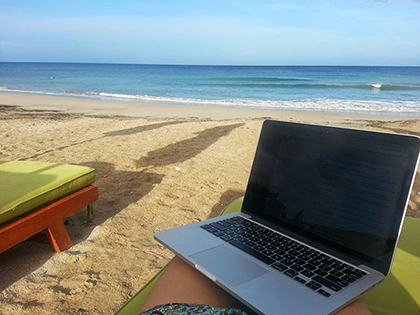
I’ve been in Costa Rica for a week now; a few more days until I fly out.

Believe it or not, I came here for work. I spoke at a blogging workshop for the first five days, at the invitation of a publishing company. About a dozen attendees came to learn about blog writing and tour this beautiful country.

(True to my “one day of freedom for each day of work” philosophy, I decided that 5 days of speaking should be followed by 5 days of beach time. So here I am, literally writing this blog post from the beach.)

In speaking at this workshop, I fulfilled a decade-old ambition: I’m “getting paid to travel” for the first time.

My younger self would flip out if she could see me now.

When I was in college, I daydreamed about finding a job that would allow me to travel to exotic locales, spotting wildlife and sampling tropical cuisine.

Fast-forward a decade, and — voila! — that dream is now a reality. My 20-year-old self would be floored if she knew.

And I’m so grateful, so happy, so blessed.

And yet —

This experience confirms an idea that’s been kicking around in my head for years: “Get paid to travel” is the wrong dream.

In fact, “get paid to travel” doesn’t exist. It’s a myth. An illusion.

(But don’t worry — there’s a stronger, better dream that you can embrace, if you want to. One that’s more honest, more authentic. Read on.)

An Important Lesson I Had to Learn The Hard Way …

Let’s rewind for a moment.

During college, I was constantly scheming ways to travel.

I wanted to go overseas. The context didn’t matter. I was young and inexperienced, and had no grasp of “context.”

Like many students, I looked into study abroad. But those semester-long programs bore steep 5-figure price tags. Gulp!

Then I realized I didn’t want the “study” — I just wanted the “abroad.” It would be a LOT cheaper to just save enough to buy a plane ticket after graduation, live somewhere for six months, and find some odd jobs to support myself.

I told my parents, who asked a logical follow-up: “What would you do there?”

I shrugged. “Maybe bartend?”

As you can imagine, that answer didn’t blow over too well.

My dad said that if I really wanted to travel, I should look for a “professional” career that would allow me to live overseas.

So my senior year, I started browsing those opportunities: The State Department. International nonprofit work. News reporting.

The State Department seemed too bureaucratic, and the global nonprofit sector seemed too competitive, so I decided to foray into journalism, figuring I’d one day become an international correspondent. To break into the field, I accepted a job as a reporter at the local newspaper, figuring that it was the first stepping stone in what would become a long and illustrious career in print media. (Ha!)

But my timing was terrible. The newspaper industry was drying up. Jobs were scarce; my possibility of landing a staff position at a major-market daily seemed slim.

After a few years, I recognized the folly in waiting around for a White Knight (your boss) to make your dreams come true. I had placed fate into the hands of gatekeepers.

If I really wanted a freedom-soaked lifestyle filled with travel and adventure, I needed to knock down the gate.

So I quit my job in 2008, and the rest is history. I haven’t been employed since, yet my income has quadrupled. I make six-figures from my laptop and I’ve traveled to more than 30 countries, spending as much time in each locale as I want.

(Like I said, my 20-year-old self would totally. flip. out. if she could look into a crystal ball and see the future me. Life has turned out far better than I’d imagined possible.)

In the process of creating all of that, though, I forgot about my original scheme, the trigger which started it all — which was that College-Senior-Paula was plotting ways she could to “get paid to travel.”

I forgot that’s what I’d wanted — until it happened. This current trip to Costa Rica is the first time I’ve ever traveled overseas for work.

And it makes me realize: That whole idea is an illusion.

Nobody gets paid to travel. We get paid for the value we bring to the trip.

And that’s where our focus needs to be.

I’m not literally getting paid to receive a passport stamp. I’m here because — (hopefully) — I can impact others and change lives through writing, speaking and teaching.

There’s a famous quote by business leader Jim Rohn — “You don’t get paid for the hour. You get paid for the value that you bring to the hour.”

The same applies here. You don’t “get paid to travel.” You get paid for the value that you bring to the trip. (If you like that, Tweet it.)

Look for Freedom, Not Commands

But hold on!

There’s more.

If we’re getting paid for creating value — and if our work transfers across boundaries — then it doesn’t matter where we are when we create that value.

“Huh?”

Okay, hear me out:

On a day-to-day basis, I work from my laptop. I could be in Kuala Lumpur or Kansas City; my location is irrelevant.

And that flexibility — combined with a good income (and strong savings) — creates far, far more freedom than any other work arrangement.

In other words –

The goal shouldn’t necessarily be “get paid to travel.” Because that — by itself — doesn’t create optimal freedom.

If I had a boss telling me to fly to Egypt for a news assignment, he’d also tell me what to do when I get there. And when to fly home. And where to fly next.

I’d be living on his terms.

But if you change the goal to “earn money from anywhere,” the game changes. Now you have the freedom to call the shots.

Context matters.

I didn’t understand this when I was 20. I thought “travel” was the same, regardless of whether it was studying abroad, working odd jobs to support myself while backpacking Europe, or representing the State Department.

Now I understand how different each of those experiences would be.

Context matters.

The old notion of “getting paid to travel” is premised on the assumption that someone else issues the command.

Don’t make that your sole goal.

Command yourself.

Want to get paid to travel? That's a lot of people's dreams, but it's actually a myth. Context matters. Here's what you should focus on instead.

You Might Also Like

  • | | | | |

    #552: The Harsh Truth About Getting Wealthy

    Dr. Brad Klontz and Adrian Brambila join us for part two of their three-part series on “harsh truths” about building wealth.

    The first truth sets the tone: being poor sucks. But they quickly distinguish between being “broke” (having no money, which can be temporary) and having a “poor mindset” (which keeps people stuck).

    Even high-income earners can have a poor mindset, they explain, sharing examples of pro athletes and celebrities who earned millions but lost it all.

    The discussion moves to whether the financial system is “rigged.” While acknowledging real systemic challenges, they argue that viewing it as a rigged system leads to powerlessness. Instead, they suggest viewing wealth-building as a game with specific rules to learn and master.

    Several guests share candid stories about their own financial journeys. Brambila describes living in a van while earning seven figures, challenging assumptions about what wealth looks like.

    Klontz reveals how he lost money day trading during the tech bubble, using that experience to warn against get-rich-quick schemes.

    The conversation tackles touchy subjects like distancing yourself from friends with poor money mindsets. Klontz shares how he had to end a friendship with his best man when their different approaches to business created tension. They emphasize this isn’t about income levels – it’s about mindset and habits.

    Through personal examples, they explore why people often undervalue their work. Brambila describes initially pricing his online courses too low due to imposter syndrome. They discuss how both employees and entrepreneurs need to understand their true market value.

    The duo challenges common beliefs about jobs, arguing that “only liars love their jobs” since most people would change how they work if they had financial freedom. They use the example of petting puppies – even a dream job becomes less appealing when you lose control over your time.

    On lottery tickets, they expand beyond just criticizing gambling to examine how get-rich-quick mindsets distract from real wealth-building strategies. Klontz shares research showing 97% of day traders lose money, using this to illustrate why seemingly easy paths to wealth usually fail.

    Throughout the episode, the guests weave together psychology, practical advice, and frank discussion of uncomfortable truths about money. While some of their statements spark controversy, they back up their positions with research and real-world examples from their own lives and their work with clients.

  • | | |

    #504: The Points Guy: Growing a Side Hustle into a 140-Person Business

    Brian Kelly faced a harsh reality during the Great Recession – $65,000 in income and crushing credit card debt.

    He started a simple side hustle, a website called The Points Guy, as an attempt to earn a few hundred dollars a month.

    Fast forward to today: The Points Guy boasts 11 million monthly visitors and a thriving team of 140 employees.

    In this episode, Brian pulls back the curtain on his incredible journey, transforming a fledgling side hustle into a multimillion-dollar enterprise.

    He also shares his signature expertise – the art of redeeming airline miles and points – empowering you to travel smarter. 

  • | | | |

    #501: Live From Brooklyn: Travel More, Work Less

    Feeling stuck in a job you hate, dreaming of exotic adventures? This episode is your escape hatch.

    Brad Barrett, host of the ChooseFI Podcast, takes the interviewer role in this special episode, recorded LIVE at a comedy club in Brooklyn.

    Brad interviews me (!!) about how I quit my reporter gig and traveled the world for over 2 YEARS! This episode spills the tea on my transformation from newspaper reporter to world wanderer, and talks about how this podcast (now over 500 episodes!) got started. Feeling inspired? This episode is your travel hack manual for designing your dream life on a budget.

    Enjoy!

  • | | |

    #401: You Are a Badass at Making Money, with Jen Sincero

    Jen Sincero says she used to be a “grouchy broke person.”

    In her early 40’s, Jen lived in a converted garage, buried in credit card debt and scrounging for spare change.

    She was the type of person who’d join her friends at a restaurant for dinner, order nothing except tap water, and fill up on the complimentary bread basket. She used duct-tape to repair her shoes. Her “splurges” consisted of buying new windshield wipers.

    Despite her struggles, Jen believed that pursuing wealth was…icky. She’d internalized negative social attitudes towards money, such as:

    Money isn’t important. People are.
    Rich people are lucky / gross / shallow.
    You can’t make money doing [insert your-dream-here].
    You have to attend a good college to make money.
    Money is out of my reach.
    It’s lonely at the top.
    Who has that kind of money?
    He/she is only about the money.

    Those negative attitudes, Jen says, were holding her back. So she created a more positive script — such as “I’m good at making money,” and “Money is a tool that helps me live my best life.”

    This attitude shift made all the difference.

    In today’s interview, Jen describes her journey from broke to badass, and she explains how everyone can become more of a maverick at making money.

  • |

    The Next Financial Challenge: 20 Contenders in a Fight to the Top

    Last year I blindfolded myself, threw darts at a list of stocks, and bought the first 10 that I hit. I let them ride for a year and showed you the results. This year I’m embarking on a ploy that’s a tad less crazy, but far more heated: I’m competing against 19 financial writers in a…