He saw the crash coming. Then did nothing.
Saying Goodbye to Alan Greenspan, 1926-2026
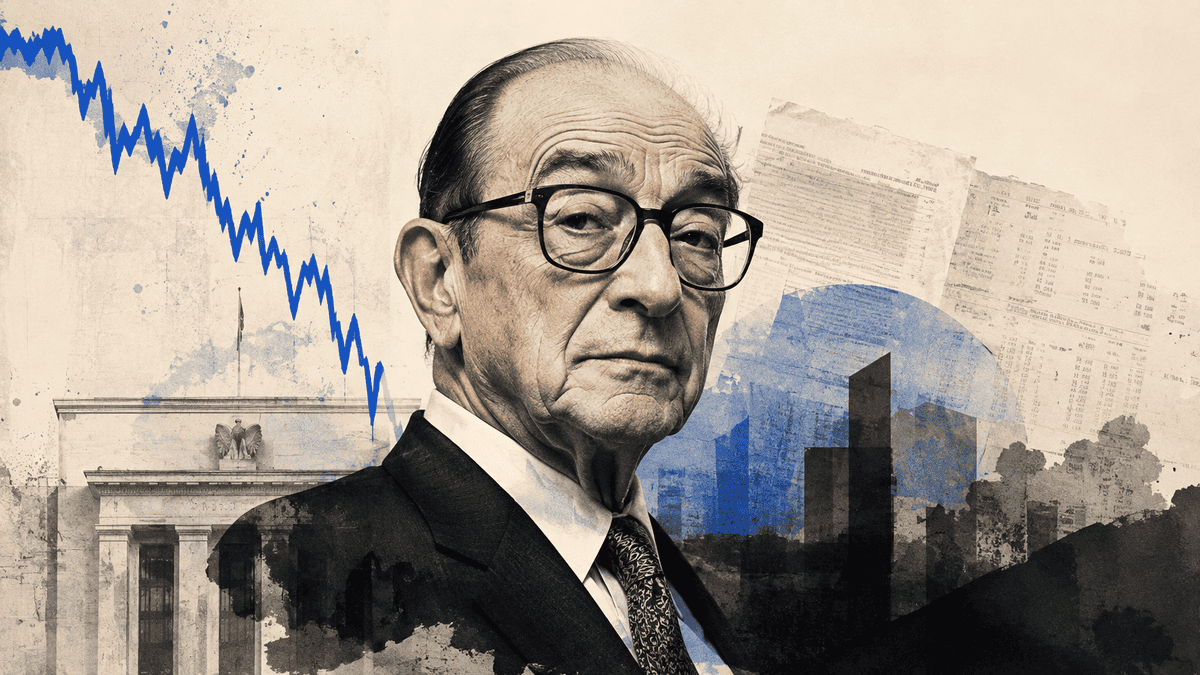
Alan Greenspan was once the most powerful economist alive.
He passed away on Monday at age 100.
He was Fed Chair from 1987 to 2006 — overseeing the economic boom of the 1990’s and early 2000’s, but missing the warning signs of the housing bubble in the years before the Great Recession.
Greenspan was the guy who would read obscure economic data rather than relying on models. He said he did his best thinking in the bathtub.I met his wife, Andrea Mitchell, at the Denver Press Club back in roughly 2007-ish or maybe early 2008-ish (?). I asked her if she ever felt stuck or stagnant in her career, which, in hindsight, was kind of a funny question for a 22-year-old to ask. She told me to always keep searching for the next challenge. I quit my job not too long after that, and have never worked for an employer since.
Before he married Andrea Mitchell (who, by the way, was 21 years younger than him), he also dated Barbara Walters. His wedding was officiated by Ruth Bader Ginsburg.
He hung out in Ayn Rand’s apartment, debating economics late into the night. He played tennis against a rotating cast of Treasury Secretaries until he was in his 80’s.
I can only assume he must’ve been great at parties.
Or maybe he wasn’t. Andrea Mitchell said that on their first date, he talked nonstop about antitrust policy.
In front of the press, he was deliberately vague. He mumbled on purpose. He knew that if he spoke too clearly, markets would move, and so he talked in circles, and no one ever really knew what he was saying.He was the guy who coined the term “irrational exuberance” in 1996 — essentially calling the dot-com bubble four years before it burst. And then he didn’t do anything about it.But on the whole, the 19 years when he was Fed Chair were largely remembered as the good times. And everyone thought that when he left the Fed in 2006, he was leaving behind a strong economy.And then everything imploded in 2007 and 2008.And he admitted in front of Congress, on the record, that his entire worldview had a “flaw.”
EFFING WHOOPS.
That “flaw” was more prominent because Greenspan created a culture inside the Fed that penalized dissent.During his time at the Fed, the board voted in lockstep. There were almost never dissenting votes.
He created a culture of the Fed presenting a unified front, which persisted until September 2024.
(If you listened to my First Friday podcast episodes in 2024 and 2025, I expressed shock when Fed member Michelle Bowman cast a dissenting vote in September 2024. That newfound practice persisted into 2025.
Today, it’s become commonplace to cast dissenting votes — something we haven’t seen since prior to Greenspan, back when Paul Volcker was the Fed Chair, 1979-1987. Greenspan was the guy who oversaw that culture change, and it was so powerful that it wasn’t unwound until now.)
“rumors of my death have been greatly exaggerated”
By the way, a little behind-the-scenes as to how newspapers operate — they pre-write obituaries.If someone is prominent and in their 70’s, 80s or 90s, every major newspaper already has their obituary written, ready to hit publish.These obits then get updated every now and again — a maintenance refresher — so that when the news breaks, they can hit publish immediately and ride that news wave.
But here’s the thing:Writing someone’s obituary when they might still have a good 15 or 20 years of life ahead is really uncomfortable.
Nobody wants to pre-write an obituary. Newspapers do it anyway because the cost of being unprepared is too high.Same reason nobody wants to create an estate plan — write a will or set up a trust. Nobody wants to have a conversation with their aging parents about finances. Nobody wants to talk about dementia or long-term disabilities, or set up a power of attorney.
It’s uncomfortable.That’s why people don’t do it. But that avoidance only makes it worse.Here’s an end-of-life / aging-parent-caregiving interview with certified financial planner Beth Pinsker. This is the steamed broccoli of personal finance, the stuff that’s good for you that you don’t really crave.
Eat your broccoli.
three recent thoughts
Stuff I’ve thought/posted recently:
1. You make money to the extent that you solve other people’s problems. As historian Joseph Moore pointed out — some people believe that the world owes them something. Others believe that they owe the world something.
2. Every dollar you spend, rather than invest, is another hour you’ll need to work later.(Well, I don’t literally mean that one hour is worth $1, but you get the gist.)
3. You either endure difficulty or you endure regret.Saving is difficult. Paying off debt is difficult. Learning to invest is difficult. Staying the course when the market collapses is difficult (helloooo, April 2025).
Surviving years of self-employment and then expanding that to hiring a team and building systems and tracking ROI and dealing with bullsh*t legal disputes and bootstrapping the whole thing is really effing difficult.
And buying a rental property is probably the reason that the exploding head emoji was invented 🤯 (kidding not kidding)Yeah dude — it’s all difficult.
And that’s why it’s worth it.Talk to literally any person who retired early or achieved financial independence, and they’re going to tell you, “Yeah, some parts of it sucked, and also I am so glad I did it.”And by the way, that same thing applies to anyone who lost a bunch of weight, built a bunch of muscle, or ran a marathon, or ran their first 5K, or went from the ability to do zero pull-ups to one pull-up.
It’s all difficult.And the only thing that’s worse than the pain of difficulty is the pain of regret.
Got questions?
We’re in the market for some questions on the podcast.
If there’s something on your mind and you want myself and my buddy, former financial planner Joe Saul-Sehy, to tackle on the podcast, head to this link and leave your question.
That’s Three Things Today! — the 9th Edition
If you enjoyed this, please forward it to a friend.If you’re the friend reading it as a forward, join us here.