The story
I bought the Anthropic IPO and it was hilarious
Let me start by saying that buying IPOs is a terrible idea.
And terrible ideas make the best stories.
Why is an IPO such a bad idea? When a company IPOs, the people on the inside — employees, investors, directors, executives — have shares that are locked up.
Over the span of the next year, those lockups end in staggered phases.
That means shares that previously weren’t public end up getting added to the market, and the forces of supply-and-demand make the prices swing when that happens.
In Anthropic’s case, it IPO’d with 980 million shares priced at $83 per share, which gives it a public float of $81 billion.
But its total public valuation is a little under $1.5 trillion. (At least that’s the number that the media keeps reporting. But $81 billion is supposed to represent 6% of the company, while the other 94% are held by the insiders. And so the math doesn’t totally square.)
Anyway, suffice to say it’s somewhere in the ballpark of $1.35 trillion to $1.5 trillion. (I could find the answer in the filings, but the juice isn’t worth the squeeze). Lil’ rounding error of $150 billion — what’s that between friends anyway?
So anyway, companies tend to have wild price swings for the first year after they IPO.
That’s true of literally any company, and Anthropic is the biggest IPO — meaning the biggest fundraise — in human history. That means huge numbers of retail investors crowding in, likely resulting in a stock that’s wilder, swingier, more speculative.
Where I’m going with this is that I think buying the IPO is a really bad idea.
And I love bad ideas.
So I’ve never purchased an IPO before, and the whole experience was a crash course in … uh … competitive paperwork? Is that a thing?
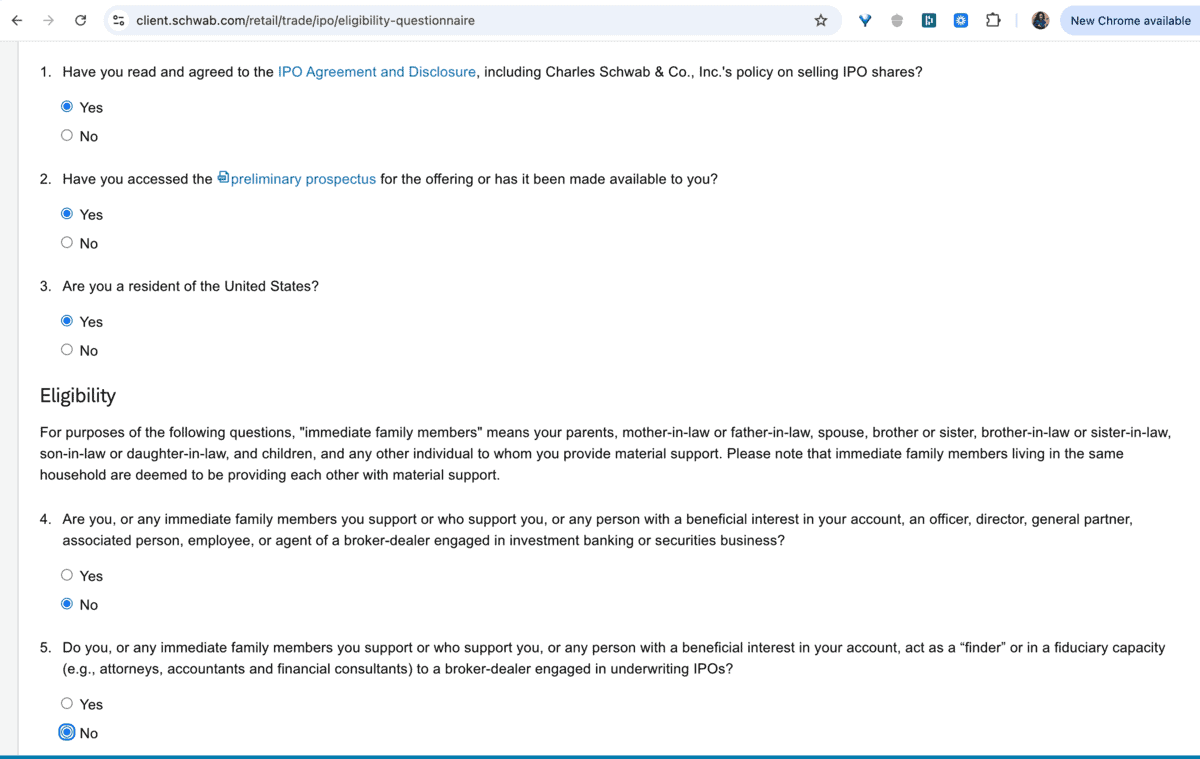
Here’s how it works. First, you have to fill out this long questionnaire. “Have you read the documents? Do you know what you’re doing? Are you a Chinese Communist Party spy?” (Whoops. Not that last one.)
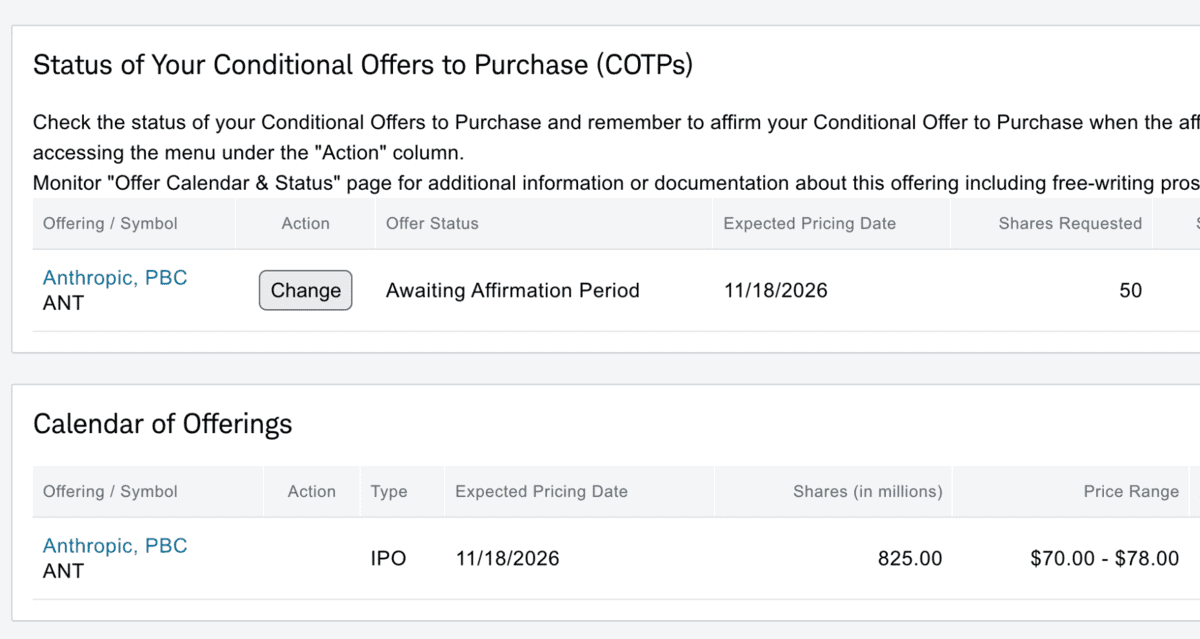
After that, you submit a “conditional offer to purchase (COTP).”
You don’t get to just buy the stock. You first tell the stock that you might want to take it out for drinks.
In this case, the COTP was at somewhere between $70 and $78 per share. Anthropic hadn’t made up its mind yet.
Also at the time, Anthropic thought they were going to issue 825 million shares — that’s important for figuring out the valuation.
I asked for 50 shares, which would have been a $3,900 investment at the upper end of the range.
But filling out a lengthy questionnaire just to request some shares isn’t enough.
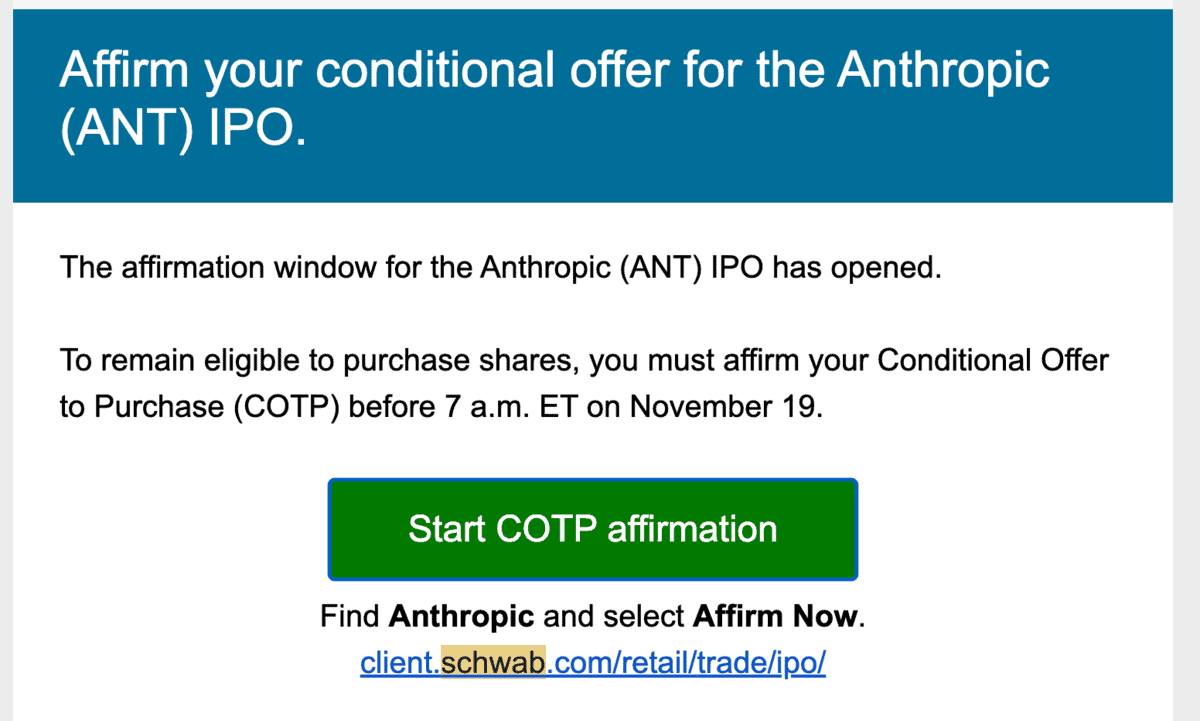
Then you have to wait until the night before, when they open up an “affirmation window” and you reconfirm that, yes, you really do want these shares.
We get to the night before the IPO, and at, I’m not joking, around 8:30 PM, I get a notification saying, “The affirmation window is now open. Deadline is 7:00 AM tomorrow.”
Cool. Okay. I get how this works now. So the window of time is 8:30 PM and 7:00 AM — and if you don’t confirm within that 10.5-hour window, you’re kicked out of the pool.
Honestly, this is like a multiple bid on a distressed rental house situation. Oh, I know this game. I excel at this game.
One of the reasons this is necessary is because Anthropic changed both the number of shares they were offering and the price, and to absolutely nobody’s surprise, both were higher — 980 million shares at $83 per share.
This means the valuation is higher and your own slice of the pie is even smaller. (But again, what’s a rounding error of a few hundred billion between friends?)
I log in, futz around with maybe the world’s most non-intuitive user interface, and declare my oath of loyalty to buying these shares. “I do solemnly swear, before God and my country …”
I wake up the next morning to discover that they’ve considered my request of 50 shares and have decided to award me …
drumroll please …
… 10 shares.
This is like getting rejected before you’ve even made it to the first date.
The thing about hot IPOs is that they’re oversubscribed.
If it’s a deal no one wants, you get every share you ask for. But if everybody wants in, they have to ration the shares.
The irony, then, is that retail investors (you and me) end up getting more of the bad IPO’s, and less of the good IPO’s. This also means you’re more likely to overpay for a hot IPO — a big crowd makes it more likely it’s bid up too high.
There’s even a fancy name for this in economics, and it’s the “winner’s curse.”
(There’s your First Principles phrase of the day.)
And so that’s how the story ends. I have a whopping $830 investment in Anthropic — enough of an investment to keep me amused, but too small to ruin Thanksgiving.
I think I’ve invested more in parking tickets over the span of my life.