Your 401k Used to Be 9 Percent Jensen Huang

First Principles

What happened? Why it matters? and What to do about it?

Every Monday.

What happened

Your 401k Used to Be 9 Percent Jensen

Most of the coverage of the Jensen Huang NVIDIA story has been about the affair and the spy allegations — because frankly, that’s the part that sounds like a Hollywood script.

But the real story underneath is that without knowing it, millions of people — pretty much anyone with a 401 or an IRA — had made a really big bet on one dude.

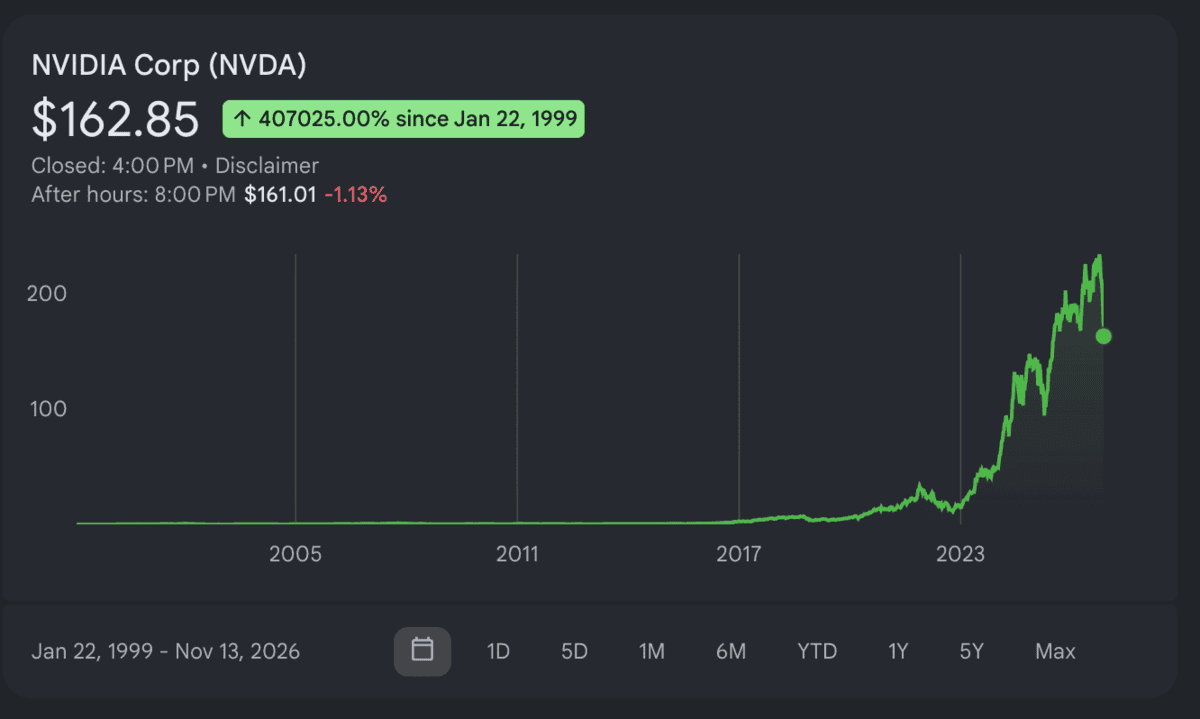
At its peak in May 2026, NVIDIA represented almost 9 cents of every dollar in the S&P 500 index.
​
Let’s think about that for a second. The S&P 500 is designed to spread your risk across 500 companies (and 503 stock listings, since some companies are listed twice, like GOOG and GOOGL).
​
Of these 500 companies, 499 consisted of 91% of the index. And just one company represented 9%.

That’s bananas.

In theory, if the S&P 500 was split equally, every company would be worth 1/500 of the index, which is 0.2 percent.

That’s one-fifth of one penny for every dollar.
​
Instead, Nvidia was 9 pennies per dollar.
​
Why such a high weighting? It’s a feature, not a bug. Historically, the overwhelming majority of stock market gains have been driven by a small handful of companies. That’s been true since the days of railroad stocks, and now is no different.
​
That’s why equally-weighted indexes underperform cap-weighted indexes, which is fancy jargon for saying splitting it equally tends to do worse than letting the winners ride.
​
But reward doesn’t come without risk. One of the risks that we face when any given stock becomes so overweighted is called “concentration risk.”​
​
Separately, a risk that any company faces if it’s too heavily dependent on its CEO is called “key person risk.” ​
​
Nvidia represents both. Concentration risk, because it’s such a big part of the index. Key person risk, because the underlying structure of the company revolved so heavily around Jensen’s decision-making.
​
Remember, this is a guy who started the company in 1993 from a Denny’s booth, where he met with co-founders Chris Malachowsky and Curtis Priem. He’s been its only CEO for the last 33 years.

During that time, he was making GPUs in an era when everyone was making CPUs. The rest of the industry thought he was nuts, and for a long time, the growth of the company was flat.

Everybody else was making money hand over fist in the dot-com bubble and throughout the early 2000s and 2010s. Meanwhile, NVIDIA — which went public on January 22, 1999, during the dot-com frenzy — spent the next 17 years being flat and unimpressive.

Jensen was committed to his vision of GPUs, which he also started in 1999. (Prior to that, he made 3D graphics chips.) Nobody else thought it was an important enough market in which to innovate.
​
For the next 27 years, he built a moat.
​
This is why no other company has been able to catch up in GPU’s. Because Jensen spearheaded a 27-year head start.
​
There’s been a lot of media coverage around the unusual structure of the company — the fact that he has 60 direct reports, whereas a normal CEO might have 10 to 12. The fact that until last week, the Board didn’t have a Chair.
​
Sure, those elements helped contribute to key person risk. But you can’t underestimate the importance of someone who held an investing thesis for three decades and stuck to it until the rest of the world eventually caught up.
​
Home Depot stock cratered after the departure of its founder, Bernie Marcus, largely because the new CEO was one of those GE Jack Welch proteges who ran the company in the way that they might teach you from a business school textbook rather than from a position of actual vision. Home Depot went through a full decade of stagnation and volatility until they finally got a CEO who went to Bernie and effectively said, “Mentor me,” and then just listened to whatever Bernie said. (Fun fact — Bernie took him to a Costco to walk the floor, because he said Costco was a better-run retailer.)

Where were we? Oh, right.

With Home Depot, as with many other companies, we’ve seen that the departure of a visionary leader often leads to the company stagnating unless and until they find a successor with that same bold vision.

If you’re selling plywood, drills, and hammers, you might be able to get away with that.

But if you’re competing in the most technologically advanced competitive market of our lifetimes, that’s significant risk.

And THAT’S why Nvidia stock is down more than 30% since October.

And with an overall index weighting that peaked at 9% in May –it’s now around 6%, smaller than Apple, about neck-and-neck with Microsoft — the fate of all of our retirement accounts hangs in the balance.

Colin Jost on SNL’s Weekend Update said it well: “Jensen Huang had a midlife crisis so bad, you might lose your house in his divorce.”

SPONSORED

What do you get when a lack of good bookkeeping help for CPAs meets demand for a work-from-home business?

The answer was given in 2015, when Ben Robinson founded Bookkeeper Launch — the course that teaches women and men how to start their own bookkeeping business. And for 11 years, Bookkeeper Launch has helped thousands become successful with starting their own bookkeeping businesses.

One such success story was Jaime Rodriguez. In March 2017, he enrolled in Bookkeeper Launch, and by the end of the year he got his return on investment. The next year he broke 6 figures. He now owns and runs Bookkeeper Launch — the course that changed his life.

What does this mean? That a bookkeeping business is an in-demand, low-startup cost profession that can change your life. And Bookkeeper Launch is the way to do it right.

​Bookkeeper Launch teaches you how to start and run your own bookkeeping business: 100+ hands-on QuickBooks Online lessons, a certification exam, and training on finding clients and pricing your work. It’s a 90-day plan, at your own pace.

Now bookkeeping isn’t for everyone. It’s a tough business, and it takes real work. But if you want an income stream where you decide when and where you work, it’s worth a look.​

Why it matters

Jensen Lost the China Argument, Too

Here’s the thing. The U.S. and China are in a tight race to see who’s going to win AI.
​
And whoever wins AI, wins.
​
Imagine a military conflict between two nations, one of which has substantially better AI capabilities than the other. Yeesh. It wouldn’t be a fair fight.
​
Right now, China is beating the U.S. in robotics.

The U.S. is beating China in advanced chips — by a LOT.

And the U.S. has a slight lead in frontier models, but it’s still anyone’s game.

The U.S.’s biggest advantage right now is chips, which is why export controls matter so much.
​
There are two schools of thought:
​
​“Hook them” — Jensen Huang has been a proponent of the idea that we should trade with China more. He argued that China is going to have AI regardless, so let’s make sure that they develop their AI on U.S. hardware.

To be clear, Jensen is not proposing some “let’s be friends” diplomatic argument. His position is that we should get China dependent on American chips and software. Dependence gives the U.S. leverage.
​
​“Starve them” — Dario Amodei from Anthropic has the opposite view. He believes we shouldn’t be selling the best, highest-quality chips to our adversaries.

Dario argues that we should starve them. Hold back our best chips so that China falls behind.
​
Both of these are arguments as to how the U.S. can win the AI race — But they’re very different strategies.
​
And when Jensen resigned from NVIDIA, he also lost the “hook them? or starve them?” argument.
​
Now that Jensen no longer holds power, the voices that are overwhelmingly suspicious of China — known as the “China hawks” — have unfettered influence. The “make them dependent” camp lost their loudest and most influential voice.

And there’s now a decent chance that the U.S. is going to clamp down on export controls.
​
There’s bipartisan support in the Senate for tighter export controls. This comes in the form of three proposals:
​
— The Chip Security Act, which would crack down on chip smuggling. (Tough time to be a Chinese spy.)
​
— The AI Overwatch Act, which would give Congress greater oversight over advanced chip exports.
​
— The Match Act, which would require U.S. allies to stop selling chipmaking equipment to China.
​
There’s also a loophole that the Commerce Department is currently trying to close — the “rent it remotely” loophole, which is how Chinese firms right now are renting access to NVIDIA chips in Malaysia and Singapore.

When Jensen lost his company, he also lost the China argument. The hawks have serious momentum.

This means (likely) fewer chips will flow to China, especially the highest-quality variety.

In the short term, that’s bad for NVIDIA’s sales, because it closes off part of their market. Jensen estimated this could be worth about $50 billion (not just to his company, but the whole market).
​
​But in the long term, more importantly, this may give China increased incentive to develop their own chips.

It’s worth asking the question, “How has the ‘starve-them’ strategy worked so far?”
​
The U.S. has restricted chips to China for years, and China has caught up anyway. Stanford’s 2026 AI index has found that the performance gap between the best U.S. and Chinese models has shrunk to only 2.7 percent — down from 17 to 31 percentage points in May 2023. In other words, the gap is narrowing.
​
That’s why Jensen argues that starving China has just made them scrappy and more efficient. DeepSeek is an example of this.

Hawks would argue that China’s homegrown chips still aren’t good enough. DeepSeek hit a wall trying to train on Huawei chips.
​
Let’s turn our attention to the question, “Does China want chips from the U.S.?”

And the answer diverges depending on whether you’re talking to everyday entrepreneurs or the Chinese Communist Party, the CCP.
​
Many Chinese entrepreneurs want chips from the U.S. — They would agree with Jensen’s side of the debate.

But the CCP wants to develop China’s internal chip-making capabilities through companies like Huawei.
​
Both the China hawks and the CCP want the same outcome, but for different reasons.

Both want China to be off of US chips. The hawks want it because they think it’ll slow China down. The CCP wants it so that they don’t become dependent on the U.S., and so that their own chip industry can flourish through companies like Huawei.

And so strangely, it looks both the U.S. and China governments are in agreement. Both governments want China to be off of U.S. chips, but for different reasons.
​
The result is going to be two separate AI ecosystems. And then the question becomes, which ecosystem will the rest of the world run on?

And whoever wins that question wins the world.

How this affects your 401k: In the short term, tighter export controls mean less China revenue for Nvidia, and that’s 6% of your index fund.

But that’s just one company. Here’s the bigger worry:
​
Chips are the biggest lead that the U.S. has in the AI race. By A LOT. (Remember, they’re absolutely smoking us in robotics.)
​
If the “starve them” strategy ends up backfiring, then our lead shrinks, and so does the reason that AI stocks are priced so high.

Now, AI stocks are the thing that’s been carrying the market for the last 4 years.

And it’s been driving a huge chunk of our GDP growth — (between one-third to one-half of GDP growth, depending on who’s counting) — and we need that growth to be strong because that’s how we outpace our deficit.
​
If we lose the AI edge and our stock market declines and GDP slows down and the deficit spirals out of control, then we would either need to get very aggressive with the levers of spending and taxes (which is going to be a political nightmare) or could we end up in a big financial crisis.

Sorry to ruin your morning coffee.

What to do about it

Your Index Fund Has No Key Person

The first section of this newsletter was about key person risk.

The second section of this newsletter was about forces outside of our control — the “hook them? or starve them?” debate.

The good news is that the S&P 500 is built to survive both.

The index fund takes care of itself. Even as Nvidia fell from 9% to only 6% of the S&P 500, the index immediately refilled its coffers with the stronger companies.
​
Your fund automatically shifted to Apple and other companies that are rising, and you didn’t have to do anything.
​
The S&P 500 has survived every “indispensable” leader. (Remember that famous quote about how the graveyards are filled with indispensable men?)
​
Steve Jobs passed away and Apple stock continued to rise. Home Depot appointed a CEO that presided over stagnation, and it lasted a decade, but through it, the S&P 500 kept growing.
​
And when Home Depot was finally ready to become a strong company again, it became a bigger part of that index.
​
There were railroads and GE and IBM at its peak. There were wars and crises and a dot-com burst. There was JCPenney (we just interviewed the former CEO) and Bed Bath & Beyond. And through it all, the S&P 500 has recovered and stayed strong.
​
​That’s the key takeaway here.

One company can have key person risk. NVIDIA can have key person risk.
​
​But your index fund doesn’t have key person risk.
​
​
Because there’s no single person that the index fund ever becomes too dependent on.
​
There are strong companies that eventually falter and drop out. New winners take their place. The circle of life continues.
​
When you invest in the S&P 500, you invest in the overall nation. And that means you can focus on things that are inside of your control.
​
You can’t control Chinese chip making. But you can control your own savings rate, your timeframe to retirement, and your commitment to not panic selling based on the headlines.


Try this: Raise the contribution to your retirement account by 1 Percent.

I refer to this as the 1 Percent Challenge — It’s a challenge I started in 2014.

If you consistently raise your retirement contributions by 1% per year — and if you had begun 12 years ago when I began the challenge — you would be saving 12% more than you were back then.
​
(If you’ve maxed out your retirement accounts, congrats! Move this over to a taxable brokerage and keep investing!)

Community corner

Did you know your index fund was THAT concentrated in NVIDIA?

Does knowing that make you more nervous? Or more confident in the index?

Send us an email at paula@affordanything.com and tell us.


P.S. If you want me to feature any companies or topics in upcoming newsletters, send us an email at paula@affordanything.com and tell us what you’d like to hear about.

Paula Pant​
Founder and host, Afford Anything

You Might Also Like