Introducing – Three Things Monday
It’s been awhile. I’m bringing the newsletter back … with something new:
Three Things Monday.
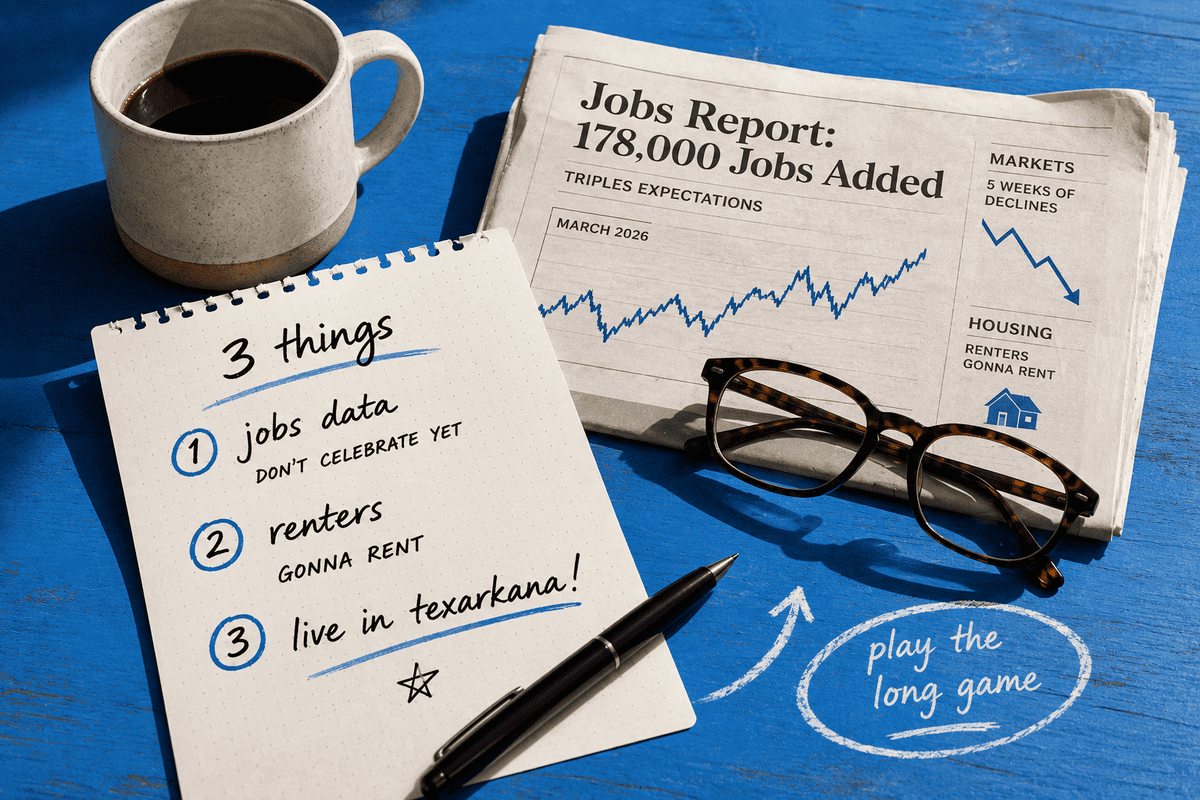
Every Monday, I’ll send you three things worth knowing as you start your week — across personal finance, the economy, and the markets.
Sometimes that’s inflation or interest rates. Sometimes it’s the stock market. I might talk about the Fed, or mortgage rates, or housing. Sometimes it’s something from the FIRE world.
It’s three things that keep your head in the game and your knowledge current, as you kick off your week.
Let’s begin!
Stocks on Sale
Today, the Dow officially slipped into what’s called a “correction,” meaning it’s more than 10 percent off of its latest peak.
Every major index has been volatile, and this is now the fifth consecutive week of declines.
This means one thing: for a long-term investor, stocks are on sale.
And when something is on sale, you stock up and buy more.
The obvious question is “why the volatility?,” and of course, the answer is uncertainty related to oil spikes, which might cause inflation, and which reduces the chance that the Fed is going to lower interest rates.
When the Fed keeps interest rates high, there’s less capital in the system, which means business owners can’t invest, and the overall economy stays sluggish. High rates plus high oil prices pack a one-two punch that slows down the economy, which is why stocks are shaken up.
And if you only had a 6- to 12-month time horizon as an investor, sure, that would be something to worry about.
But if you’re investing for more than 10 years, these drops provide a great opportunity.
The fundamentals haven’t changed. AI is accelerating productivity. The U.S. economy is leading in terms of innovation. There’s plenty of reason to be bullish for the long-term.
These are short-term jitters that are spooking investors who are thinking in quarters, not decades.
Don’t take your cues from the people who think in quarters.
The stock market is on sale right now, which means my next move is to — (no pun intended) — stock up.
Gen X, Are You Okay?
New survey data came out about how much money people have saved for retirement — and it’s not looking good.
All age groups are behind in retirement savings, but ages 45 to 54 are in the worst position, according to an analysis from the nonprofit National Institute on Retirement Security (NIRS).
NIRS looked at Census data for workers ages 21 to 64, and compared actual retirement savings to the benchmarks that Fidelity recommends.
They found that all groups had saved less than 25 percent of Fidelity’s recommended benchmark, with the age 45-54 cohort in the worst position, with only 16 percent of the benchmark saved.
To be fair, there’s controversy over Fidelity’s benchmark, which states: “at least 1x your salary at 30, 3x at 40, 6x at 50, 8x at 60, and 10x at 67.”
I could poke many holes in that benchmark, including:
(1) it benchmarks retirement savings to your salary rather than your spending;
(2) many people in careers with huge educational and training requirements are still in grad school at 30, and don’t see their salaries blossom until they reach around 35, at which point they’re paying back a wad of student loans … give them some breathing room, and they’ll catch up by 50;
(3) none of this takes home equity or debt into account, both of which can be a substantial portion of a person’s net worth, positive or negative
(4) salary itself is so dynamic a person’s peak earning years — which, for many people, is in their 40s and 50s — doesn’t have any relationship with what you’ll actually spend in retirement. A better benchmark ties your savings to your expected expenses, not your peak income. (okay, I get that I’ve just repeated Point One, but I’m pretty fired up about that)
But I digress.
Controversy over Fidelity’s benchmark aside, the latest headline is that if we accept that benchmark at face value, we can see that no one’s doing well, and Gen X is doing the worst.
Let’s hope they’re sitting on a bunch of home equity.
Your Money or Your Life?
If you’ve spent any time in the FIRE community, you’ve probably come across Your Money or Your Life.
It’s one of the foundational texts in this space.
This morning, one of its co-authors published something that changes how that story is understood.
It’s not an easy read. I don’t like that I have to share this. But it relates to a book that’s had an outsized impact on the FIRE movement, which is why I’m sharing it.
Vicki Robin, co-author of Your Money or Your Life — the book that launched the FIRE movement in 1992 — published a Substack article today alleging that her coauthor, Joe Dominguez, engaged in abusive behavior.
“I joined his genius publicly, and hid the abuse,” she wrote.
“Years before we wrote Your Money or Your Life, I realized that this pattern would never change,” she said.
Your Money or Your Life sold more than 1 million copies and created the foundation of the modern FIRE movement. It was an NYTimes bestseller and spent more than 5 years on the BusinessWeek bestseller list.
Even 30 years later, the book is still hugely influential.
In 2018, Money Magazine featured Vicki Robin on its cover, with the headline: “A Growing Cult of Millennials is Obsessed with Early Retirement. This 72-Year-Old is Their Unlikely Inspiration.“
The cover story was a deep dive into the early retirement movement, and hailed Your Money or Your Life as its genesis.
Money Magazine said: “The FIRE movement looks at this text as a bible of sorts.”
Robin and Dominguez were both co-authors and romantic partners, and toured the country promoting the idea of financial independence. They appeared on hundreds of TV and radio shows, including Oprah, Good Morning America, and NPR. They were written about in the New York Times, the Wall Street Journal, People Magazine, and Newsweek.
Dominguez passed away from cancer in 1997 at age 58.
That’s the end of the first Three Things Monday.
Please hit reply and let me know if you have any feedback, anything you want me to cover … and if you’re part of Gen X, any hope for retirement.
I’ll be back next week with three more updates from the world of markets, economics, retirement, and personal finance.