
Author: Paula Pant

  • |

    #308: Ask Paula – I Want to Travel After I Retire; How Much Should I Save?

    [smart_track_player url="https://traffic.libsyn.com/secure/paulaandjaymoney/AA308.mp3" title="Ask Paula - I Want to Travel After I Retire; How Much Should I Save?" artist="Paula Pant" social="true" social_twitter="true" social_facebook="true" social_gplus="true" social_linkedin="true" social_stumble="true" social_pinterest="true" social_email="true" ]

    Anonymous in Virginia wants to travel after retiring, which will increase her expenses for the first seven or so years of her retirement. How can she plan for a higher withdrawal rate at the beginning of retirement, and a lower withdrawal rate in the middle of her retirement?

    Given the talk around student loan forgiveness, Jess wants to know: should she pay the minimum on her student loan debt and save the payments she would otherwise make? Or should she keep throwing extra at her higher interest loans?

    Ziggy purchased an $890,000 property in San Mateo, CA in 2016. After living there for a year, he had to move, so he rented it out. Unfortunately, it’s cash flow negative. Is this property worth holding onto, or should he sell?

    Vivek has a paid-off primary residence that he’s interested in renting out for a few years, before selling. He’s worried about capital gains tax – does turning the home into a rental impact the amount he’ll pay?

    My friend and former financial planner, Joe Saul-Sehy, joins me to answer these questions on today’s show. Let’s dive in!

  • |

    #307: The Tax Risks That Could Blow Up Your Retirement Plan, with Ed Slott

    [smart_track_player url="https://traffic.libsyn.com/secure/paulaandjaymoney/AA307.mp3" title="The Tax Risks That Could Blow Up Your Retirement Plan, with Ed Slott" artist="Paula Pant" social="true" social_twitter="true" social_facebook="true" social_gplus="true" social_linkedin="true" social_stumble="true" social_pinterest="true" social_email="true" ]

    “Taxes are the single biggest factor that separates people from their retirement dreams.”

    That’s a quote from today’s guest, Ed Slott, a nationally recognized IRA distribution expert, CPA, and bestselling author.

    If you’re like most members of the Financial Independence Retire Early (FIRE) community, you understand the massive tax challenges inherent in retirement planning. Strategies such as the mega-backdoor Roth are popular because the FIRE community loves to optimize for taxes.

    Ed does, too.

    His book, The New Retirement Savings Time Bomb, is about how we can diversify and manage our tax risk so that we can achieve our financial independence and early retirement dreams.

    So … what should we do?

    Ed is a big proponent of Roth accounts because they’re an easy, widely-available solution. His Traditional IRA has a balance of $0.

  • |

    #306: Ask Paula & Joe – How to Shift From Financial Independence to a Mini-Retirement?

    [smart_track_player url="https://traffic.libsyn.com/secure/paulaandjaymoney/AA306.mp3" title="Ask Paula: " artist="Paula Pant" social="true" social_twitter="true" social_facebook="true" social_gplus="true" social_linkedin="true" social_stumble="true" social_pinterest="true" social_email="true" ]

    Jake and his wife want to retire in five years, at which point they’ll have 14 years before they can access their 401k funds. To help bridge that gap, Jake wants to know: what should their asset allocation look like for their taxable brokerage account?

    This year, Kim’s employer enrolled all employees into a “fully funded indemnity program combined with a nationwide direct primary care membership.” What the heck is this program, and how might it impact Kim’s finances?

    Burnt Out in Boston is switching their focus from financial independence to taking a mini-retirement. How can they financially and mentally prepare for this leap?

    Matthew is torn: should he and his wife – both 26 – max out their Roth IRAs and then save up for a rental property, or simply save cash for the rental and worry about their Roth later?

    Finally, Deva and her husband are fed up with their messy tenants. They’re kind and responsible, but they’ve left the yard a mess. They have a clause in the lease that addresses this, so beyond that, what can they do?

    My friend and former financial planner, Joe Saul-Sehy, joins me to answer these questions on today’s show. Enjoy!

  • |

    #305: The 7 Steps to Financial Independence + 7 Rules of Investing, with J.D. Roth

    [smart_track_player url="https://traffic.libsyn.com/secure/paulaandjaymoney/AA305.mp3" title="The 7 Steps to Financial Independence + 7 Rules of Investing, with J.D. Roth" artist="Paula Pant" social="true" social_twitter="true" social_facebook="true" social_gplus="true" social_linkedin="true" social_stumble="true" social_pinterest="true" social_email="true" ]

    “What’s your FI number? What’s your FI date?”

    People often talk about financial independence like it’s a fixed, static point. When your portfolio reaches $X value, or your monthly passive income is $Y per month, you’re FI.

    “When did you reach FI?,” people will ask, as though it’s a one-way door with a distinct date, comparable to graduating from high school or college.

    Today’s podcast guest, J.D. Roth, offers a fresh perspective: FI isn’t a fixed point. It’s a continuum, a spectrum.

    He says there are seven stages along the road to financial independence, which include:

    1: Dependence: This is what we experience when we’re five years old: total reliance on someone else.

    This is also what we experience as adults if we depend on our credit cards for basics like groceries and utilities, and we can’t pay the balance in full at the end of the month.

    2: Solvency: You can make your minimum payments, and you’re not adding new credit card debt to your monthly balance.

  • |

    #304: Ask Paula & Joe – Help! I Can Only Save $200 a Month

    [smart_track_player url="https://traffic.libsyn.com/secure/paulaandjaymoney/AA304.mp3" title="Ask Paula: Help! I Can Only Save $200 a Month" artist="Paula Pant" social="true" social_twitter="true" social_facebook="true" social_gplus="true" social_linkedin="true" social_stumble="true" social_pinterest="true" social_email="true" ]

    Paige and her fiancé have two autumn 2021 goals: save for a wedding and an emergency fund. There’s one problem: they only have around $200 per month to save. How can they grow the gap when they’ve run out of things to cut and ways to earn more?

    Kat’s investor friend connected her with a wholesaler who only deals in cash. How can she find $130,000 to buy her subject property?

    “Jon,” an anonymous caller, is renting his grandparent’s property, which he plans to make his forever home. It’s on the older side and needs renovations, but the repairs don’t need to happen immediately. How can he fund these repairs while also avoiding a mortgage payment in his 60s?

    Anonymous caller “Chadwick” is planning for financial independence. Given that his employer covers his housing, when should he and his wife look for a house? Now, or in the last year of his job?

    Annalis wants to know whose approach to business I prefer: Gary Vee’s, or Cal Newport’s? She also asks: how do you become a good speaker?

    My friend and former financial planner Joe Saul-Sehy joins me to answer these five questions today. Enjoy!

  • |

    #301: Ask Paula – How Can I Reach FIRE in 11 Years?

    [smart_track_player url="https://traffic.libsyn.com/secure/paulaandjaymoney/AA301.mp3" title="Ask Paula - How Can I Reach FIRE in 11 Years?" artist="Paula Pant" social="true" social_twitter="true" social_facebook="true" social_gplus="true" social_linkedin="true" social_stumble="true" social_pinterest="true" social_email="true" ]

    Sarah wants to refinance her owner-occupied triplex, but she’s torn between a 15-year and a 30-year option. Which is better in her situation?

    Amelia is worried that she and her husband are under-insured. Should her husband get a short-term disability policy, even though it’s expensive and they’re unlikely to need it?

    Steven just discovered the financial independence (FI) movement in July 2020, and he wants to reach FI in 11 years. He has $30,000 in cash and $26,000 of student loan debt. How should he use his cash given his FI goal?

    The South American Anthropologist wants to make a career change. His baby daughter has inspired him to become an example of living life on your own terms. Will his financial independence plan sustain him and his family for years to come?

    Annalis and Mike are hunting for their first rental property, but they haven’t found anything nice that meets the one percent rule. Should they purchase a mansion and rent the rooms on Airbnb?

    My friend and former financial planner Joe Saul-Sehy joins me to answer these five questions in today’s episode. Let’s dive in.

  • #300: The Two-Fund Investment Portfolio, with Paul Merriman

    [smart_track_player url="https://traffic.libsyn.com/secure/paulaandjaymoney/AA300.mp3" title="The Two-Fund Investment Portfolio, with Paul Merriman" artist="Paula Pant" social="true" social_twitter="true" social_facebook="true" social_gplus="true" social_linkedin="true" social_stumble="true" social_pinterest="true" social_email="true" ]

    Target date retirement funds are simple, automated, easy.

    The problem? What’s simple might not be optimal.

    Investment expert Paul Merriman joins us to discuss the two-fund portfolio, a mix of one target date fund and one small cap value fund. He describes why this could be the ultimate portfolio for buy-and-hold investors who want to boost their returns, without excessive complexity or risk.

    Here’s the idea behind a two-fund portfolio:

    • Your age x 1.5 = the percentage of your portfolio in a target date fund
    • Invest the rest in a small cap value fund

    According to Merriman, this simple strategy could dramatically improve long-term aggregate returns without creating too much volatility or complexity.

  • |

    #299: Ask Paula and Joe – Should I Sell My $575,000 in Tesla Stock?

    [smart_track_player url="https://traffic.libsyn.com/secure/paulaandjaymoney/AA299.mp3" title="Ask Paula and Joe: Should I Sell My $575,000 in Tesla Stock?" artist="Paula Pant" social="true" social_twitter="true" social_facebook="true" social_gplus="true" social_linkedin="true" social_stumble="true" social_pinterest="true" social_email="true" ]

    Chris bought Tesla a few years ago and Jinko Solar eight months ago. Both of these have gone up in value by a lot. What tax strategies can he use to sell these shares?

    Holly and her three sisters stand to inherit two side-by-side duplexes. How can they structure the ownership of these properties in a fair way?

    Eric feels hopeless about health insurance as a self-employed business owner. Are DPCs or healthshares the way to go?

    Frank and his wife have a nine-year retirement plan that involves selling their home and moving to Costa Rica. How can they maximize their savings and existing investments to set themselves up for success?

    My friend and former financial planner Joe Saul-Sehy joins me to answer these four questions on today’s episode. Enjoy!

  • The FIRE Take on Wall St Bets, GameStop, and Meme Stonks

    The investor community is split into two factions: FIRE vs. YOLO. The YOLO crowd includes the people who read Reddit’s r/WallStreetBets, who chase speculative trades, who place margin trades on Robinhood. They share stock tips on Discord and bet on whatever appears in their chat feed. Earlier this week they piled investments into Galway Metals,…

  • PSA Thursday Part II: Let The People Trade!

    [smart_track_player url="https://traffic.libsyn.com/secure/paulaandjaymoney/AA297c_PSA_Thursday_Memestock_Part_II.mp3" title="PSA Thursday Part II: Let The People Trade!" artist="Paula Pant" social="true" social_twitter="true" social_facebook="true" social_gplus="true" social_linkedin="true" social_stumble="true" social_pinterest="true" social_email="true" ]

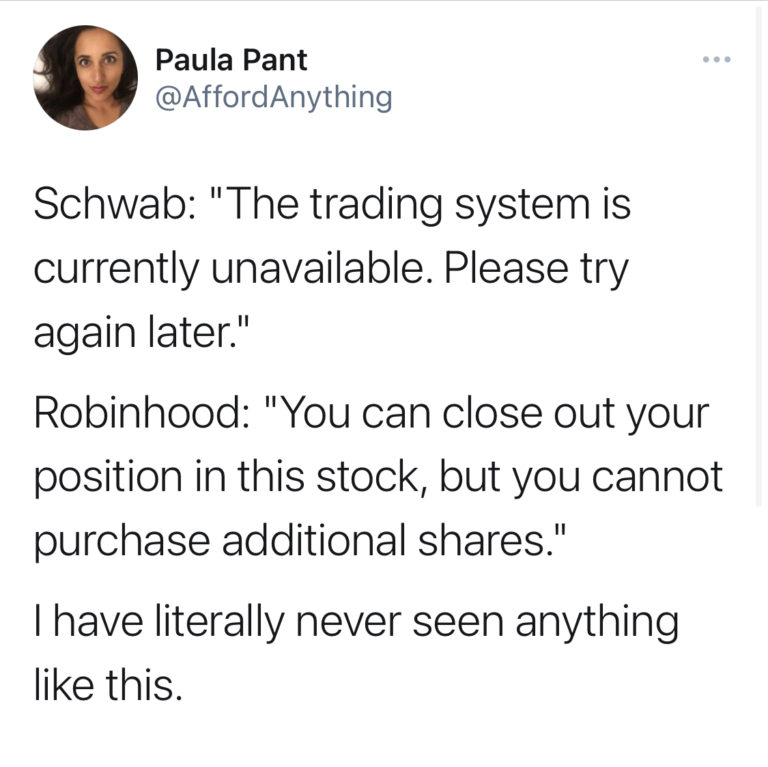
    This morning, almost every major brokerage halted trading on the most volatile stocks, including GameStop, BlackBerry, Bed Bath & Beyond, Nokia, and AMC Theaters.

    We’re in a situation where major trading platforms are blocking retail investors – us – from placing trades, while allowing hedge funds and institutional investors to drive prices.

    That is not a free market.

    When you don’t let people buy, and you don’t let people sell, you’re locking people out of the game entirely.

    Yesterday, I was worried that grandma and grandpa would make the wrong investment choices and irrationally bet their life savings away. Now, they’re prohibited from making any choice. ?

    We deserve the right to make our own trading decisions.

    For the latest updates, follow me on Twitter or Instagram (check out my stories). I’m sharing my thoughts on these platforms as things unfold.