Do you hate flying as much as I do? Find flying cramped and tiring, to the point where you wish teleportation was a thing? Then read these tips on how to make long flights tolerable.

How to Make Long Flights Tolerable

Do you hate flying as much as I do? Find flying cramped and tiring, to the point where you wish teleportation was a thing? Then read these tips on how to make long flights tolerable.

Here’s the funny thing: I hate flying.
⠀
Yet I’ve taken 18 flights in the last 9 months. Including one Wednesday. And my next flight is today.⠀
⠀
To be clear — I’m not afraid of flying. I just don’t enjoy it. It’s noisy. It’s cramped. I can’t sleep. I can’t concentrate. I feel drained and exhausted afterwards. ⠀
⠀
Since I’ve been on the road (um, in the air) so much this year, I realized I needed coping strategies to make long flights tolerable. Here’s how I manage the irritations of flying, and how I keep costs to a minimum:

#1: I avoid layovers whenever possible. I’ll rearrange dates and plans, if needed, to fly nonstop.⠀
⠀
#2: I avoid early-morning flights. Catching a 10 a.m. flight means leaving home by 8 a.m. Anything earlier is just cruel and unusual. (International flights are different, but there’s more flexibility with domestic itineraries.)⠀
⠀
#3: I reach the airport at least 1 hour and 15 minutes before domestic flights, even though that’s overkill. I also allow 30 minutes for the ride to the airport, even though I can usually Uber there in 20. Building these time buffers helps me relax.⠀
⠀
#4: I love TSA PreCheck; I can’t imagine flying without it. If you value your time at all, sign up for this program immediately. (More below.)
⠀
#5: I’ve made a rule for myself: No working on flights. I hold flights as special time for my favorite hobby, reading books, and I read anything I want, not necessarily business/money books. Yesterday I started reading the latest Dan Brown novel.⠀
⠀
#6: I wear noise-cancelling earmuffs to drown the engine noise. This makes a HUGE difference.⠀

noise cancelling earmuffs⠀
#7: Although I have access to many airline lounges, which feature open bars, I don’t drink alcohol when I’m flying. It just makes me dehydrated and cranky.⠀
⠀
#8: Speaking of cranky — I always carry snacks. Although that’s a good practice for life.

How to Keep Flying Costs Low (without Losing Your Mind)

Flying is expensive — right? Nope. Here’s how I trim costs (without flying Spirit).

#1: Let’s start with ground transportation. Uber and Lyft both have a ‘carpool’ option, in which you can snag a cheaper price by sharing your ride. Since people are always heading to/from the airport, this is an easy way to save money on ground transit.

#2: Check public transit options both at home and at your destination. In Dallas, for example, I discovered that the light rail arrived immediately in front of my hotel. Goodbye, $25 Uber; hello, $2.50 rail ticket.

#3: Build airline miles by paying for everything with a rewards credit card. Paid-in-full always, duh! 🙂

#4: Redeem miles for at least 2 percent. If a flight costs $400, for example, I’ll only pay for that same flight with 20,000 or fewer miles. I’ve found the best redemption values on international flights and upgrades.

Here’s a handy chart.
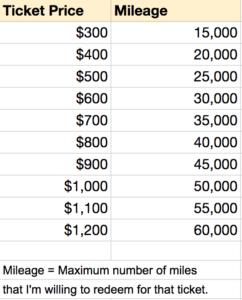
Why? Simple: If I earn one mile per dollar, and I redeem those miles at two percent … well, the math is obvious. It’s like I’m saving two percent on every purchase.

If I also get a signup bonus, I’m in the 3-4 percent zone. Sweet!

Tip: Grab at least one card that gives you complimentary access to airline lounges. This is icing on the cake — or more accurately, it’s guacamole on the chip. Which leads to my next point —

#5: Devour the airport lounge snacks: hummus, cheese, olives, veggies, soups, chocolate-chip cookies. Many lounges offer a free guacamole bar, which is basically my definition of heaven. I refer to airport lounges as the Executive Soup Kitchen, and thanks to these, I haven’t bought food at an airport in years.

Tip: Eat everything in sight. (Wait, is that just me?)
Extra Tip: Send the chocolate-chip cookies through the revolving-belt toaster. They come out warm and gooey.

#6: (If you’re a U.S. citizen) —
Applying for TSA PreCheck costs $85. Applying for Global Entry, which streamlines your re-entry to the U.S. from abroad, costs $100 and includes TSA PreCheck. So for an extra $15, you get access to both programs and can jump the line.

Duh. This is a no-brainer deal. (Also, some credit cards will reimburse your application fee.)

#7: (If you’re self-employed) —
Many of my trips have a business component, which means I can write-off most of the costs. This gives me an effective 25-35 percent ‘discount,’ so to speak.

I’ll fly to Seattle for face-to-face meetings, for example, or I’ll fly to Austin for a conference. Since I’m traveling there anyway, I’ll spend an extra few days exploring the area.

To make bookkeeping easy, I pay for the trip’s business expenses with a business card, and personal expenses with a personal card. Voila, it’s automated.

#8: (Also if you’re self-employed) —
One of the coolest things about the laptop lifestyle is the blurry line between “business meeting” and “hanging out with friends who share your passion.”

For example —

I met Emma Pattee from a cold email. She asked me to speak at an event she was organizing. I said no.

She emailed again a year later. I said no.

Sounds like a great start to a friendship, doesn’t it?

But once we met, we clicked instantly, and in July we flew out to Alabama to check out rental properties together. We stayed up late every night drinking red wine and eating key lime pie. It was awesome.

I love hanging out with her. But every hangout session is also super-productive. And that leads me to perhaps the best frugal hack of all: love what you do — and whom you do it with — so much that it doesn’t feel like work. Love it so much that this is what you’d be doing anyway. And then wait for that moment of joyous surprise when you realize that the IRS doesn’t have any restrictions against liking the people that you work with.

After all, isn’t a “mastermind group” just a formalized version of having friends?

____

So … that’s how I make flights tolerable.

I shared this on Instagram and Facebook the other day, and several people offered awesome recommendations, as well — get a seat located in front of the engines, take a shower when you land, and start flying by private jet (WTF?? Huh??)

If you have any more ideas, I’m all ears. Well, muffled ears. 🙂

Do you hate flying as much as I do? Find flying cramped and tiring, to the point where you wish teleportation was a thing? Then read these tips on how to make long flights tolerable.

You Might Also Like

  • | | |

    #749: How a Blind Man and his Guide Dog Survived Sept. 11 — and What His Mindset Can Teach Us, with Michael Hingson

    On September 11, 2001, Michael Hingson was on the 78th floor of the World Trade Center’s North Tower with his guide dog, Roselle, when the first plane hit. Over the next hour, they walked down 78 flights of stairs together, calm the entire way. Michael later wrote about that day in Thunder Dog, a New…

  • | | | | |

    #748: Q&A: My Dream Job Won’t Wait If I Take a Family Gap Year. Do I Quit Anyway?

    “So to me, this is not a money management question.” That’s what I told Jamie, a 42-year-old PA with $686,000 saved, right after she described her plan: quit the job she loves and take her husband and kids on a family gap year while they’re still young enough to remember it. She wasn’t asking if…

  • | |

    #719: Your Office Is Making You Sick, with Dr. John La Puma

    Did you know that the average modern office worker spends a staggering 93% of their life indoors? While the hustle to achieve financial independence often pushes us to put our heads down, stare at monitors, and clock endless hours inside a climate-controlled box, we might be accidentally sacrificing our long-term cognitive and physical health in…

  • |

    #606: Can You Really Afford to Die? – with Hospice and Oncology Nurse Suzanne O’Brien

    Hospice nurse and end-of-life educator Suzanne O’Brien joins us to discuss the financial realities of dying in America — and they might surprise you.

    Remember Aretha Franklin?

    Her handwritten will was found in her couch cushions after she passed away. Despite her substantial wealth, this simple document was legally upheld. It’s a powerful reminder that having any form of will is better than none at all.

    But there’s more to worry about than just having a will or trust. The costs of aging and dying can add up fast.

    Long-term care costs can quickly deplete even substantial savings. Suzanne shares a story about a couple with over $5 million who were shocked to learn how quickly 24/7 care for dementia would consume their nest egg.

    Traditional funerals average between $7,000-$11,000, but there are much more affordable alternatives:

    • Home wakes and natural burials can cost just a few hundred dollars
    • Water cremation offers an environmentally friendly option
    • Whole body donation to medical institutions costs nothing while contributing to education

    Planning ahead gives you control over these decisions and spares your loved ones additional stress. Multi-generational living arrangements can also reduce caregiving costs and address concerns like isolation and safety for aging family members.

    Suzanne also shares stories about the emotional side of dying. Did you know some people seem to choose when they go? She tells us about a 99-year-old woman in a coma who somehow held on for days until she turned 100, then passed away that very night.

  • | |

    #596: First Friday: Tariffs Grab Headlines, But These Financial Changes Nobody Is Talking About Will Impact You Too

    Yesterday, the White House rolled out the biggest tariffs in a century, sending markets into their worst decline since the pandemic. While headlines focus on supply chains and inflation, there are important economic stories you’re not hearing about.
    During the first half of this month’s First Friday episode, we dig into what nobody’s talking about. And in the second half, we grapple with the headlines.
    Student loan rules just changed again. The government added new limits to Public Service Loan Forgiveness. Right now, 9.2 million people — one in five borrowers — can’t keep up with payments. Many folks don’t even know payments started again after that four-and-a-half-year break.
    S&P just dropped a new report that backs what smart money already knows: index funds crush actively managed funds 90 percent of the time. Even with all those tech stocks dominating the market, you still come out ahead with simple indexing.
    You know who’s gobbling up the mortgage market? Rocket Companies. They just bought both Redfin and Mr. Cooper. They’ll handle one of every six mortgages in America. They’ve positioned themselves at every step of the homebuying journey — from when you search for homes on Redfin to financing and monthly payments for the next 30 years.
    The White House just made a surprising move with Bitcoin. They’re setting up a Strategic Bitcoin Reserve to hold coins long-term. They’re also creating a separate stockpile for crypto they seize in legal cases. Pretty clear signal that Bitcoin stands apart from other cryptocurrencies.
    In the second half, we dive into those significant new tariffs making headlines.
    The S&P 500 dropped 4.8 percent on Thursday — we haven’t seen a drop like that since the pandemic. The new rules put at least a 10 percent tariff on everything coming into the country. Then come the “reciprocal” rates: 20 percent for European goods, 27 percent for items from India, and a combined 65 percent for Chinese imports.
    We bring in Bob Elliott to make sense of this situation. His credentials are impressive — he spent 13 years at Bridgewater Associates (the world’s largest hedge fund), served as head of Ray Dalio’s investment team, and graduated magna cum laude from Harvard.
    During the 2008 crisis, he directly advised the Treasury, Federal Reserve, and White House.
    Bob offers a reality check about bringing back manufacturing jobs: you can’t build factories overnight. These investments take years, and companies hesitate to make 30-year commitments when policies change every few months.
    Bob breaks down four economic forces all hitting at once: tariffs jacking up prices, government cutting spending, tax policies on hold, and the Fed moving like molasses. Put them together? Yikes. He doesn’t sugarcoat it — the short-term outlook looks “pretty negative.”

  • |

    #594: How to Travel on $75 Per Day, with Nomadic Matt Kepnes

    Ever wonder if you could afford to travel for months at a time? According to Nomadic Matt, who’s visited more than 100 countries over the last 19 years, you can see the world on just $75 a day. That’s about $27,375 per year, less than many people’s current cost of living.

    Matt Kepnes, better known as Nomadic Matt, joins us to challenge common assumptions about travel costs. He explains that long-term travel can actually be cheaper than staying home. 

    When you’re traveling, you shed many regular expenses that eat into your budget back home, like car payments, home insurance, and utility bills.

    The key is to “travel like you live,” as Nomadic Matt puts it. This means using public transportation instead of taxis, shopping at local markets, and seeking out free activities — just like you might do in your hometown.

    It’s not about staying at five-star resorts, but experiencing destinations authentically while keeping costs reasonable.

    Nomadic Matt also breaks down several travel myths. The old advice about booking flights on Tuesdays? Outdated in today’s algorithmic pricing world. Using incognito mode to get better flight prices? No evidence supports this idea. 

    He does confirm that booking round-trip flights often costs less than one-way tickets, even if you don’t use the return portion.

    For those interested in credit card points, Nomadic Matt recommends choosing cards based on your specific travel goals rather than chasing the most popular options. Consider which airlines you use most and what perks you’ll actually take advantage of.

    The pandemic has transformed travel in significant ways. While prices have increased and some budget travel services have disappeared, new opportunities have emerged — especially for remote workers who can now take advantage of digital nomad visas to live abroad while maintaining their income.

    Whether you’re planning a two-week vacation or dreaming of becoming location-independent, Nomadic Matt’s practical advice shows how international travel is more accessible than you might have thought.