

Inflation is back. Here’s what to do.
Welcome to Three Things Monday — three things worth knowing as you start the week.
Let’s begin!
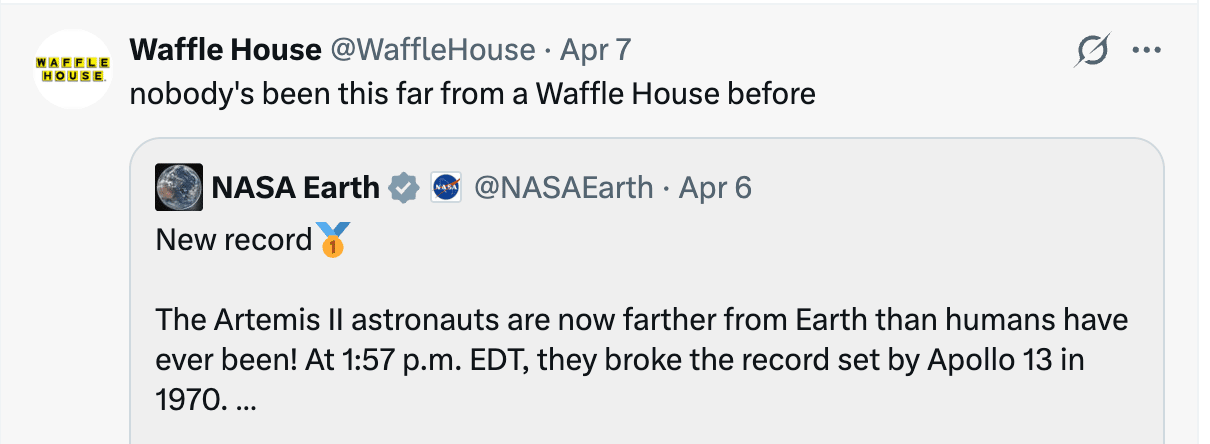
Nobody Has Ever Been This Far From a Waffle House
After 10 days in space, the Artemis II mission returned to Earth on Friday, though not before capturing the most epic solar eclipse photos in history.
It was the first crewed moon mission since 1972, and the astronauts traveled further away from Earth than any humans have ever traveled, which led to this absolute banger tweet from Waffle House.
The commander of the mission, Reid Wiseman, later explained why he signed up for a mission that was this tough.
Because the reality is that he doesn’t need to do it.
“I could have a very comfortable life for [my daughters],” he told the Wall Street Journal.
He could have stayed home. Had a comfortable life. Hung out with his family. Avoided risk. Avoided hardship. I don’t know his finances, but I’m guessing he’s probably work optional. (At least, that’s how I’m interpreting that quote.)
And so, if he is work optional, then why is he opting for it? That’s the question people always ask — If you could have a comfortable life … why wouldn’t you just take it? Why not chill more?
Wiseman answered it beautifully:
“But I’m also a human, and I see the spirit in their [my daughter’s] eyes that is burning in my soul too,” he said. “And so we’ve just got to never stop going.”
And that’s why.
The goal isn’t to build a life where nothing is hard. The goal is to build a life where hard things feel worth it.
A life in which you choose your hard.
The Most Depressing Headline in Recorded Human History
Speaking of the WSJ, they ran this —
Where Does Our Free Time Go in Retirement? Too Often, It’s Social Media (paywall, but don’t worry — I’ll summarize it below)
The piece is a first-person column from two retirees. They say that without external structure — no bosses, deadlines, or meetings — there’s nothing to interrupt zombie doomscrolling.
“We retirees have a particular vulnerability,” writes one of the co-authors, Stephen Kreider Yoder, a retired WSJ editor. “We have time on our hands and no external authority telling us to snap out of it.”
“Let’s have a show of hands: How many retirees have ended a day looking up from the phone, wondering where the time went and feeling the mental equivalent of having finished off a family-size bag of potato chips?”
“Yeah,” he writes. “That’s what I thought.”
We spend decades trying to buy back our time … and then spend it staring at our screens.
Structure actually protects our time. And so, if you opt not to work (at least in the income-producing sense of the word), then you have to build that structure yourself — and actually stick to it.
And that’s hard. But that’s the point — it’s the hard you choose.
Inflation is BACK!
The CPI report dropped on Friday and … inflation is BACK, baby!!
For those unfamiliar, the CPI is the Consumer Price Index, and it measures inflation in two ways.
One version measures inflation including food and fuel, because (duh) these items make a huge difference to most households. This is called Headline CPI.
Another version measures inflation excluding food and fuel, because these are volatile and impacted by natural disasters, extreme weather, animal and crop diseases, and loads of other factors that wouldn’t necessarily point to long-term inflation per se. This is called Core CPI, and it’s usually the number that policymakers use.
Okay, the latest numbers are out for March, and it’s not good no matter which way you slice it.
Headline CPI rose 0.9 percent for the month — AHEM, for the MONTH — which pushed the annual inflation rate to 3.3 percent. That’s the highest since 2024.
This was largely driven by a surge in energy costs, most notably gas prices, of between 10.9 to 12.5 percent. (If you’re looking for a tiny sliver of good news, the cost of smartphones is down 1 percent. So congrats on your cheaper iPhone, I guess.)
Core CPI is sitting at an annual rate of 2.6 percent, up from the previous month’s 2.4 percent rate. This number isn’t awful — it’s still in the two-handle zone — but it’s trending in the wrong direction.
This is likely because higher energy prices tend to bleed through to other CPI categories. What happens in the gas tank, happens everywhere.
(Ohhhh I’m resisting the urge to make a “what’s driving inflation” pun. Get it? Driving? … ok, ok, I’ll see myself out.)
What should you do? Remember, there are two asset classes that have historically beat inflation — equities and real estate.
And during periods of high inflation, people tend to gravitate toward tangible assets — gold, art, real estate. And of the tangible assets I just named, the first two are speculative, but the third actually has an income stream.
So if inflation is on your mind, it’s worth thinking about exposure to both.
In practice, that usually looks like broad-market index funds in your retirement accounts, and — depending on your situation — rental real estate.
These have both outpaced inflation over the long term.
This is the third edition of Three Things Monday.
Three closing things:
First, hit reply and tell me what’s on your radar — markets, housing, your budget, student loans, retirement, or something you keep hearing about but don’t quite get yet. These shape what I write next. And thank you!
Second, if you know someone who’d enjoy this, feel free to forward it along. And if that’s you — if you’re reading this as a forward — welcome. You can subscribe for free here.
Third, I’ve been playing around with this retirement planning tool from our friends at Boldin. It’s basically an AI-powered dashboard that lets you ask “what if?” questions using your actual numbers — things like:
“What if I move to Arizona?” or “What if inflation spikes?” or “What if the market drops so much that it makes the 2008 recession look like kindergarten?”
And it’ll re-run these scenarios using your Social Security estimate, tax rates, long-term care costs, and more. If you’re curious, give it a try.
More next week.