Free Download · The Takeaway
Get smarter with money in five minutes.
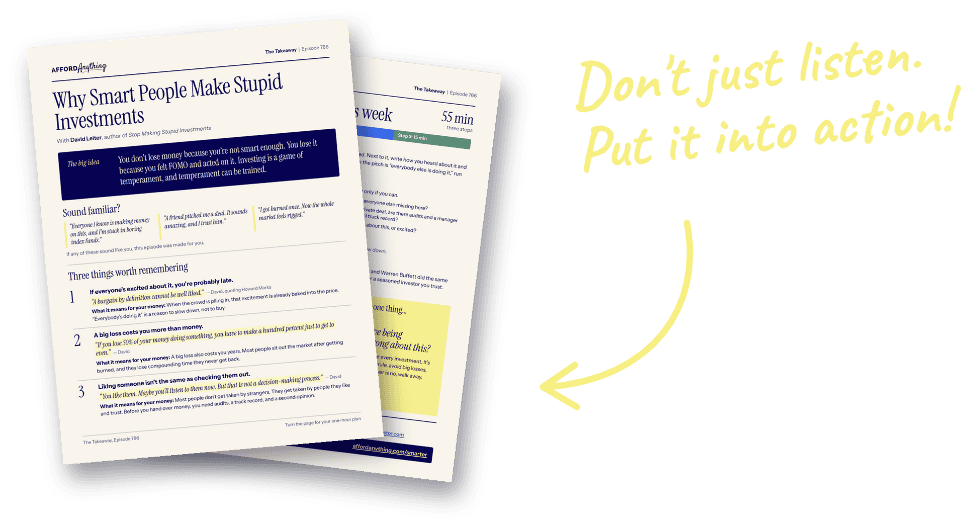
The big idea from Episode 771, plus a one-hour plan to act on it this week. Two pages, free.
- ✓The one idea from this episode that matters most for your money
- ✓Three steps you can finish in under an hour
- ✓A quick fill-in to apply it to your own numbers
Free. Lands in your inbox in a minute.
A $60 sweater sells. A $100 sweater marked down to $60 sells better, even though the shopper pays the same amount either way. That’s Black Friday psychology in a single price tag.
Behavioral scientist Jeff Kreisler says the markdown does more than make a deal look good. It hands the brain an easy comparison, letting it skip the harder questions: is this worth $60, and what else could that money do?
Then the day piles on: a countdown clock, an “only three left” banner, a coworker announcing they’re buying 20 things today. All of it pushes shoppers to think fast instead of slow.
Jeff came back on the show to unpack the two biggest drivers of Black Friday psychology, social proof and relativity, and what JCPenney’s short-lived “fair and square” pricing experiment says about why shoppers love a markdown. He also shares two simple ways to avoid overspending, including a trick he calls “advise yourself.”
Then the conversation moves beyond Black Friday psychology: why tap-to-pay is quietly erasing the pain of paying, how to turn that same convenience into a savings tool, how to make New Year’s resolutions last past February, and how to make giving a habit instead of a one-day event.
Key Takeaways
The biggest ideas from the conversation
+
- A markdown replaces the question that matters: A $100 sweater marked down to $60 outsells a plain $60 sweater because the comparison does the thinking, so shoppers stop asking whether it’s worth $60 at all. Jeff calls this relativity, and it’s one of the strongest forces in Black Friday psychology.
- Everyone else isn’t doing what you think: At a conference of millennial investors, attendees guessed 85% of the room had put their own money into crypto; the real number was 15%. Social proof, the other big driver of Black Friday psychology, runs on perception rather than reality, so check whether people like you are doing it.
- Preload a spending limit before the sales start: Decide in advance how much you’ll be glad you spent two weeks from now, then load only that onto a debit card. Hitting the limit won’t stop you, but it forces a pause, the same way ten small bags of popcorn slow you down more than one big one.
- Ask what you’d tell your best friend: People give better, calmer advice to others than to themselves. Jeff’s “advise yourself” technique imagines a friend facing the same purchase, which slows the decision down; it’s the same reason many top financial advisors have advisors of their own.
- Make frictionless payments work for your goals: Tap-to-pay erases the pain of paying, which makes overspending easy. Jeff suggests setting spending caps or alerts, reviewing your statement without judgment, and pointing the same automation at saving, the way a 401(k) sets money aside before you ever see it.
- Small, measurable goals beat big New Year’s resolutions: Aim to save $100 a week, not $100,000 in 2027, and give yourself grace when a week slips. Pair a hard habit with a reward, like an audiobook saved for the gym, but know that outside rewards alone rarely build lasting habits.
Resources
Links, tools and references mentioned
+
Chapters
Jump to a specific part of the conversation
+
Note: Timestamps are approximate and may vary across listening platforms due to dynamically inserted ads.
You Might Also Like
-
“Gold can stay static longer than you can stay solvent.” That’s how I summed up Joe’s take on gold while we answered a listener we nicknamed Detective Sam, who wants to know the best inflation hedge if prices start climbing 6 to 9 percent a year. Should he own real estate, REITs, TIPS, or gold?…
-
Free Download · The Takeaway Get smarter with money in five minutes. The big idea from Episode 769, plus a one-hour plan to act on it this week. Two pages, free. ✓The one idea from this episode that matters most for your money ✓Three steps you can finish in under an hour ✓A quick fill-in…
-
“Gifts from my parents are out of my control.” That line came from a listener’s voicemail, and it’s the smartest way I’ve heard anyone think about financial help from parents. Her parents have close to $10 million and plan to give her and her brother up to $38,000 a year in financial help while they’re…
-
Free Download · The Takeaway Get smarter with money in five minutes. The big idea from Episode 767, plus a one-hour plan to act on it this week. Two pages, free. ✓The one idea from this episode that matters most for your money ✓Three steps you can finish in under an hour ✓A quick fill-in…
-
Free Download · The Takeaway Get smarter with money in five minutes. The big idea from Episode 766, plus a one-hour plan to act on it this week. Two pages, free. ✓The one idea from this episode that matters most for your money ✓Three steps you can finish in under an hour ✓A quick fill-in…
-
“Yesterday was the worst day for stocks since April 2025.” That’s how I opened this episode, which I recorded the morning after a stock market sell-off that erased $2.3 trillion from the Nasdaq 100 in a single day. But before we get to what happened, we start where every First Friday starts: with the labor…